Of Pets, Cattle, Cryptids, and Haunted Livestock
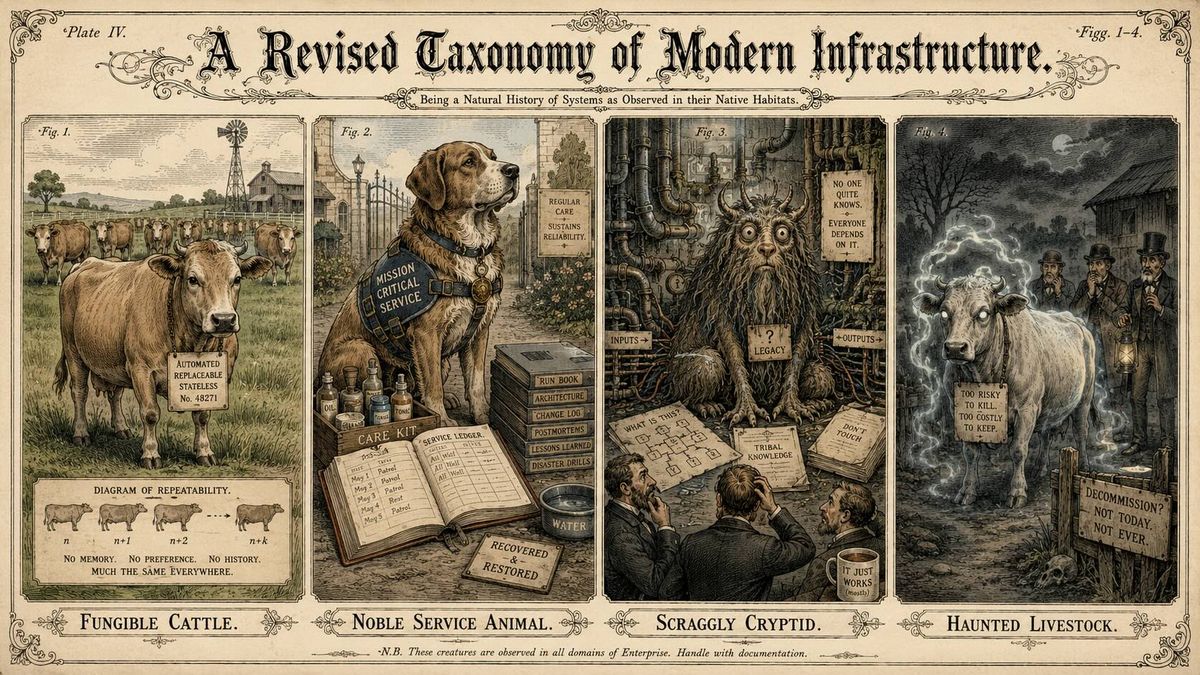
In the spirit of the finer satirists of our species, we humbly present the following modest proposal to revise the “pets versus cattle” taxonomy of modern infrastructure. The old formulation has served nobly, mostly as a blunt instrument. It has helped many organizations aspire toward automation, disposability, reproducibility, and the serene confidence of knowing that any one server may be escorted behind the barn without emotional ceremony. But like all useful metaphors, it has suffered the terrible fate of being repeated in meetings.
We began with good intentions. We wished to escape the era of artisanal servers: hand-reared machines with nicknames, mysterious shell histories, and the snowflake delicacy of Fabergé eggs filled with cron jobs. We wished to stop treating production hosts as irreplaceable companions. We wanted infrastructure that could be rebuilt, scaled, patched, and replaced without the entire organization gathering around the terminal like villagers watching a bridge inspection.
Thus came cattle: replaceable, stateless, automated. A noble category. A cattle instance does not ask for affection. It does not remember the old data center. It does not contain one local configuration file that was changed at 2:13 a.m. in 2019 by a contractor whose badge stopped working when the pandemic hit. Cattle are born from images, configured by code, observed by telemetry, and removed without eulogy. In a just world, all routine compute would be cattle.
But a just world is not where most production environments are hosted.
For reasons that are generally defensible when examined individually and alarming when viewed collectively, many systems cannot be reduced to cattle. They have state. They have dependencies. They have licensing constraints, vendor appliances, antique middleware, regulatory obligations, or the kind of business process that began as a “temporary exception” during a leadership transition in 2016. And so we propose a second category: service animals.
Service animals are special, stateful, documented, recoverable, and actively cared for. They are not cattle, but neither are they indulgent pets. They have jobs. They are trained. They wear a vest, metaphorically speaking. Nobody should be embarrassed that they exist. A database primary, a carefully managed integration host, a legacy reporting system that prints the checks that keep the lights on: these are not failures of modern engineering. They are responsibilities.
The important distinction is care. A service animal has runbooks. It has backups. It has owners. Its feeding schedule is known. Its recovery procedure has been tested by someone not currently experiencing cardiac symptoms. Its quirks are documented in prose rather than preserved as oral tradition among three senior engineers and a Slack thread called “do-not-touch-this-lol.”
Unfortunately, not all special systems receive this honorable treatment. Some drift, by institutional gravity, into our third category: cryptids.
Cryptids are machines, services, or integrations that nobody fully understands, but upon which the business appears to depend. They are spoken of in lowered tones. Their diagrams contain arrows labeled “maybe.” They often have names like prod-old, payments-final-v2, or do-not-reboot. They are observed indirectly, through footprints: a nightly job completes, a report appears, a vendor receives a file, customers are not screaming. This is taken as evidence of health.
The cryptid is not born from negligence alone. More often, it is the fossil record of success. A team solved a problem under pressure. The solution worked. The company grew around it. The people who understood it moved on, moved up, or moved to Montana. Documentation was deferred because the system was “temporary,” and nothing is more permanent than a temporary system that generates revenue.
Finally, we arrive at haunted livestock: allegedly cattle, but everyone is afraid to terminate one.
Haunted livestock are perhaps the most tragic result of the original metaphor’s overconfidence. On paper, these instances are replaceable. They live in an auto scaling group. They were created by Terraform. Their names are random. Their tags proclaim ephemerality. Yet when one misbehaves, the room goes quiet. Someone says, “Let’s not cycle that during business hours.” Someone else says, “I think that one has the good cache.” A third person, pale and sweating, asks whether anyone remembers what happened last time.
This is how best intentions mutate. We declare cattle, but smuggle in memory. We automate creation, but not validation. We rebuild servers, but not confidence. We produce infrastructure that looks disposable from the outside while carrying invisible obligations on the inside, like a shipping container full of porcelain.
The proposed taxonomy is therefore not an insult, but a plea for precision. Cattle are wonderful. Service animals are honorable. Cryptids deserve investigation. Haunted livestock require compassion, sunlight, and probably a maintenance window.
The goal was never to hate pets. The goal was to stop pretending that affection, fear, and recoverability are the same thing.