No Exit: When a Systems Theory Guy Walks into a Dungeon
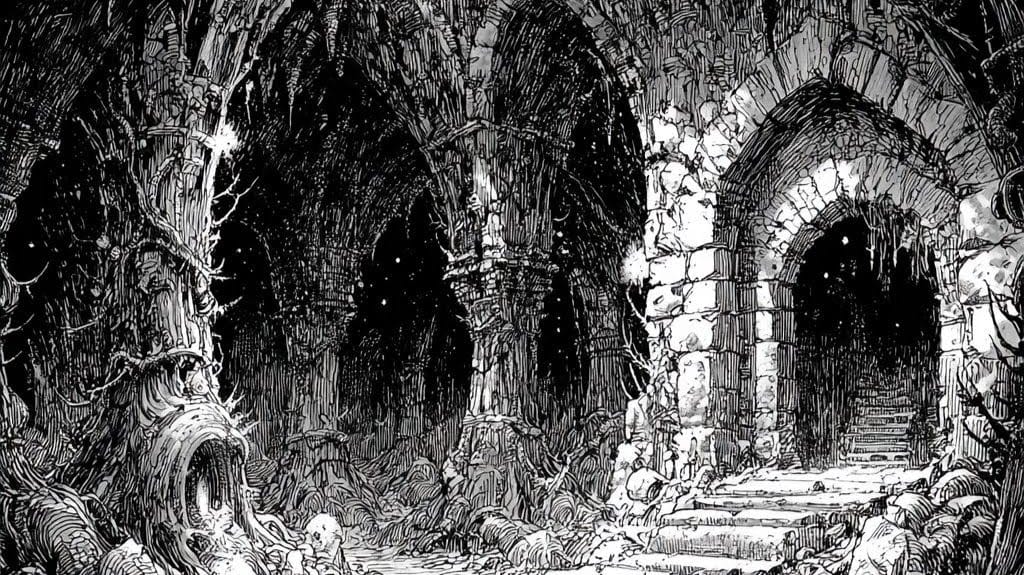
A Systems Theory Guy walks into a dungeon.
This is not, at first, a joke. It’s an accident. He picked up a dungeon crawler novel expecting low-stakes grotesquerie: profanity, cartoon violence, the literary equivalent of a stress ball. Instead, somewhere between the loot tables and the severed limbs, something snagged. A faint sense of recognition. The unpleasant kind.
The book, as advertised, follows a man trapped in an alien-run death game that looks suspiciously like a massively multiplayer online role-playing game. Floors. Levels. Spectators. A relentless demand to keep moving. On the surface, it’s a satire of modern gaming culture, particularly the endless treadmill of 21st-century MMOs.
But the Systems Theory Guy did not experience it as satire.
He experienced it as an audit.
Once you enter a system with a certain mental switch flipped, you stop asking what the system claims to be for and start asking a more irritating question: what does this system reliably produce? Not what it promises. Not what its designers say in interviews. What it actually does, over time, at scale.
The dungeon’s answer is immediate and consistent. It produces continued participation. Engagement. Content. Viewership. The suffering is not incidental; it is instrumental. The cruelty is not chaotic; it is governed. Nothing here is broken. Everything is working.
The protagonist, Carl, has choices. Clever ones. Brave ones. Occasionally ethical ones. What he does not have is an exit. There is no log-out button, no retirement tier, no dignified fade-out. Survival is participation. Resistance is content. Even refusal becomes spectacle.
This is where the unease begins.
The Systems Theory Guy has seen this shape before, wearing friendlier skins.
At this point, an impatient reader may roll their eyes. MMOs? Really? People play too much, burn out, quit — that’s not a systems critique, that’s a lifestyle choice. Nobody forced anyone to raid. Nobody chained anyone to a subscription. Calling this “harm” sounds like blaming the game for being played.
Again: fair, and still incomplete.
The issue was never that MMOs demanded time. Plenty of hobbies do. The issue was how they structured obligation. Raid schedules that functioned like shift work. Progression systems calibrated to penalize absence more than failure. Social architectures where reliability mattered more than enjoyment. “Working as intended” didn’t mean the game was fun; it meant the engagement curve was stable.
What players learned — often without naming it — was that endurance mattered more than mastery, and presence mattered more than pleasure. The grind wasn’t a side effect of play; it was the mechanism by which commitment was measured and belonging enforced. Leaving didn’t just mean stopping a game. It meant abandoning a role, a schedule, and a social identity that existed nowhere else.
That pattern is what matters. The MMO was simply an early, unusually legible version of a design logic that would later appear everywhere else.
The Systems Theory Guy realizes, with some irritation, that the book is not really about games at all.
It is about systems that offer meaning, mastery, belonging, and identity — and then refuse to let those things survive outside themselves.
Jobs that reward years of specialized competence and then strand you when the internal vocabulary shifts. Platforms where your social world collapses the moment you stop performing visibility. Creative communities where absence reads as disappearance. Moral economies where virtue must be continuously signaled or it quietly expires.
Participation is framed as choice, but the costs are asymmetrical. Entry is easy. Exit is theoretically possible and practically punishing. You consent without full information, and the bill arrives later, when your skills don’t travel and your sense of self turns out to be context-locked.
Here, a skeptical reader may shrug and say: this is just adulthood. Everything meaningful involves compromise. Complaining about that isn’t insight; it’s nostalgia with better vocabulary.
The objection is fair — and insufficient.
The difference is not that adulthood involves compromise. It always has. The difference is what those compromises produce. In functional adulthood, compromise accumulates. Skills generalize. Relationships persist. Judgment transfers. You give something up, and what you gain eventually stands on its own.
The dungeon offers compromise without accumulation. Endurance does not create leverage. Mastery does not travel. Belonging expires on exit. What you become inside the system is legible only inside the system. Leaving does not cost you comfort; it costs you coherence.
That is not maturity. It is indefinite probation masquerading as responsibility.
This is why the book stops feeling like parody and starts feeling diagnostic.
Carl sees this clearly. He understands that every act of cleverness, every crowd-pleasing survival, feeds the machine that is killing him. He understands that he is complicit — not gleefully, not cynically, but factually. There is no innocent position left. Acting produces harm. Refusing to act produces erasure.
The book offers him no moral consolation. There is no fantasy of purity or overthrow. Just the flat truth that continuing to exist means continuing to participate.
Carl’s mantra — “No, I won’t let this break me” — is therefore not heroic. It is Sisyphean. A holding action. A refusal to allow the system to complete its work internally.
This is where the Systems Theory Guy flashes back to high school philosophy: French existentialists arguing about responsibility without guarantees. About dirty hands. About the absence of exits. About the idea that refusing to choose does not absolve you — it merely relocates the consequences.
Existentialism, long dismissed as adolescent nihilism or godless theatrics, turns out to be relevant again. Not because it invented despair, but because it articulated agency under total systems. No transcendence. No just-world payoff. No clean hands.
Carl does not enjoy his complicity. He does not pretend it ennobles him. He simply refuses to let it hollow him out.
The Systems Theory Guy recognizes the pattern. Systems rarely require belief. They require continuation. Your labor produces value whether you are enthusiastic or bitter. Participation stabilizes the structure whether you praise it or critique it.
This is how harm becomes banal. Not through villains, but through alignment. Metrics that reward continuation. Responsibility diffused so evenly that no one feels it, even as it accumulates.
The NPCs in the dungeon are the clearest proof. They are not tragic because they are trapped. They are tragic because they have adapted. Mascots. Vendors. Fixtures. Their survival is the system’s success metric.
Carl refuses that fate. Not because he believes he will escape, but because becoming part of the scenery would be a different kind of death.
Near the end, the Systems Theory Guy notices the final irony: the book itself has become a series of expansions. New floors. New mechanics. More content. The critique reproduces the form it dissects.
This is not hypocrisy. It is demonstration. Systems absorb even their own critiques. Endings are bad for engagement. Closure is expensive.
The reader’s desire to skip ahead — to just read the ending, whenever it comes — is not impatience. It is literacy. A recognition that the middle is where the grind lives.
The Systems Theory Guy closes the book with an uncomfortable clarity. The dungeon is not an aberration. It is a cartoon version of the ambient condition of the 21st century: coherent, efficient systems that measure success by their own continuation.
There may be no exits.
But there remains a difference between being crushed and being complicit with open eyes.
How long even that difference can survive is… unclear.