Neighbors: Tenants Not on the Lease
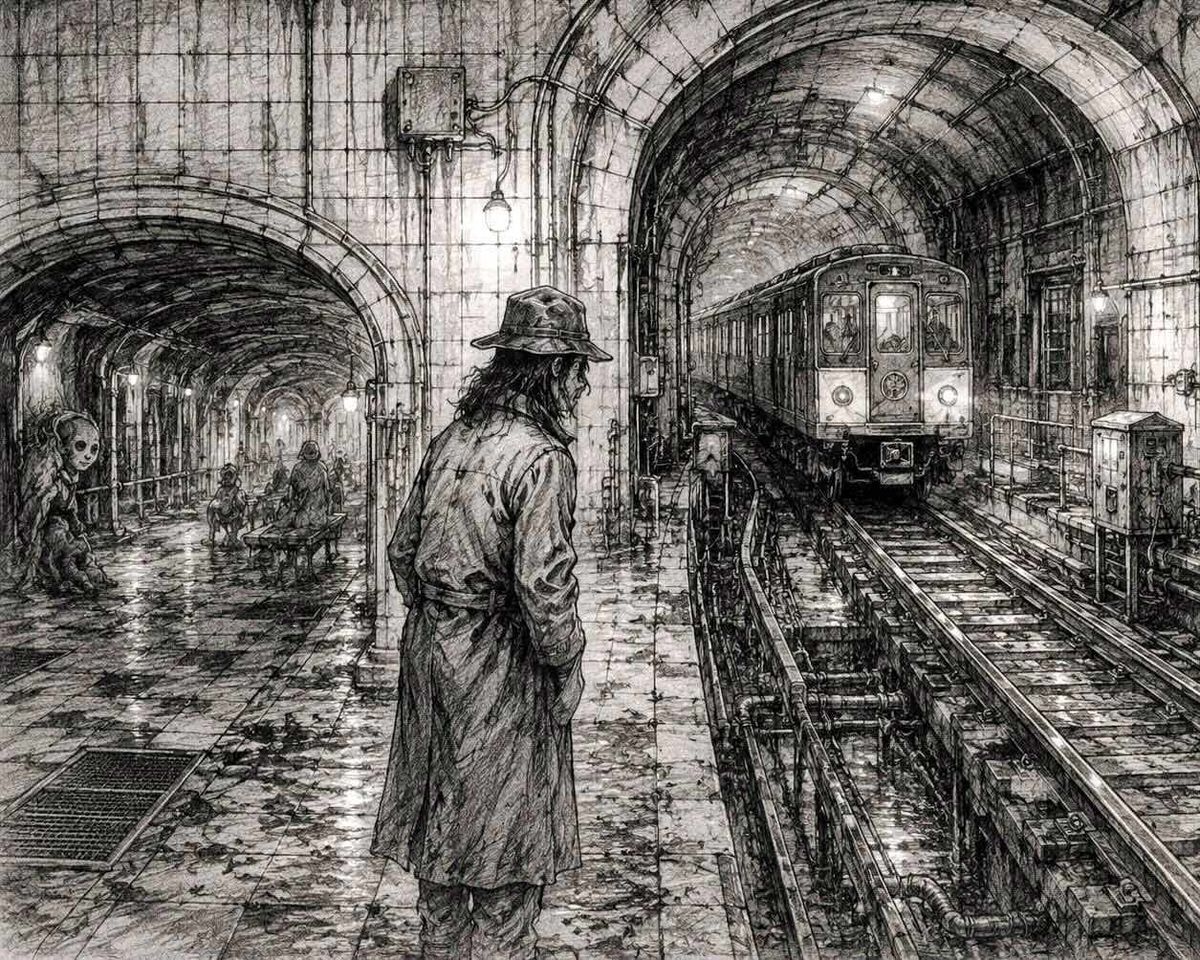
A yōkai bestiary for Neighbors
Ten folkloric Neighbors, moved out of the mountains and into the city.
ABOUT THIS SUPPLEMENT — READ THE LICENSING FIRST
This bestiary adapts 《刀と妖怪 — Espadas y Yōkais》 by Mechanical Past (mechanicalpast.itch.io), a bestiary module for 《Espadas y Espectros》, a role-playing game by Sergio Martínez, licensed CC BY-NC 4.0. That source is explicitly human-made, without generative AI, by a creator with dreams and passions — please support the original at the link above.
The ten creatures below are yōkai of Japanese folklore, which are public-domain traditional culture; the specific coexistence framings that inspired this adaptation come from Mechanical Past's module, and are credited to it with thanks. The original's illustrations are drawn from Toriyama Sekien's Gazu Hyakki Yagyō (画図百鬼夜行, 1781) and Hokusai's Denshin kaishu Hokusai manga (伝神開手北斎漫画, vol. 3, 1828), courtesy of the Smithsonian Libraries and Archives.
Important — license compatibility. Because the source module is CC BY-NC 4.0, this adaptation inherits the NonCommercial restriction. The core Neighbors playkit is CC BY-SA 4.0 (via TiGGR), which permits sale — this supplement does not. Keep it as a separate, free, non-commercial companion. Do not fold it into any sellable product, and do not relicense it BY-SA.
This supplement: © the adapting author, released CC BY-NC 4.0, in honor of the source. Attribute Mechanical Past and Sergio Martínez. Never sell it.
HOW TO READ A NEIGHBORS BESTIARY
Neighbors has no combat stat line — no hit points to grind down, no attack rolls to trade. So these entries drop the source's Esbirro/Jefe combat values and reframe each yōkai through the game's actual questions. Every entry gives you:
- Scale — Minor (a small Neighbor; a light case, often settled by one right gesture) or Big (a significant Neighbor; runs a full episode, uses Agitation 10 and the Vehicle rules — ordinary force does nothing, only the right key reaches it).
- Urban Haunt — where this mountain-or-forest spirit lives now that the city has grown over the old landscape.
- Surface Read → Truth — what frightened people assume, and what it actually needs. Discovering the Truth is the middle scene.
- The key — what settles it. Never a weapon. An offering, a custom, an acknowledgment, an invitation.
- Disposition — where it starts on the Ledger.
Two of these ten are genuine predators in the folklore. They get special handling — see The Man-Eaters and the Membrane Test at the end.
THE BENIGN NEIGHBORS
1. KODAMA — the century tree
Scale: Big (it is the tree). Urban Haunt: the oldest tree on the block — the one the city has scheduled for removal for a road-widening, a development, or a insurance liability.
A spirit that lives in a tree old enough to have seen a hundred springs. In the old country it guided the lost; in the city it has watched the neighborhood grow up around it. You can tell it's near when an echo comes back a half-beat late, tangled in something deeper than the street.
Surface Read → Truth: The block's "unlucky corner" — accidents cluster there, equipment fails, the removal crew keeps having setbacks. → The tree spirit is defending itself against the saw, the only way it can. It is not cursing the neighborhood; it is bracing for its own death.
The key: save the tree. Get the removal cancelled, the designation changed, the root protected. Do that and you receive the Favor of the Kodama — once per case, when you roll to find your way to something or someone, roll with advantage. The neighborhood's oldest resident owes you. (Cut the tree down and you are cursed instead — see the source's Maldición. Don't.)
Disposition: wary → grateful, entirely on what you do about the saw.
2. TENGU — the one who tests the powerful
Scale: Big. Urban Haunt: a rooftop, a park, a high place that overlooks the district — the spirit of a space that refuses to be dominated.
Half-bird, half-person, ascetic and martial, keeping to itself above the churn of the human world. The tengu despises anyone who uses force, fear, or artifice to dominate others — and it is watching the block's landlords, bosses, and bullies with interest.
Surface Read → Truth: Something is targeting powerful people — a developer's plans keep failing, a slumlord is tormented, a strongman is humiliated. It seems malicious. → The tengu is not attacking the powerful; it is testing them, and testing you. To the vile it issues a duel. To those who prove virtue — and especially those who fight for others' freedom — it grants passage, guidance, and gifts. This is the Tester conversion (see the playkit's Membrane Test): recognition through challenge, not a killing.
The key: demonstrate virtue and humanity — not strength. Meet its challenge honestly, or prove your dedication to others' freedom, and it stands down and helps. Try to beat it by force and you've failed the test by taking it. Prove yourself and you may receive a tengu feather: snap it and the tengu appears at your side.
Disposition: testing. It resolves to ally or adversary based on what you show it — never on what you say.
3. YAMABIKO — the echo in the infrastructure
Scale: Minor. Urban Haunt: the acoustic city — subway tunnels, stairwells, parking structures, underpasses. Anywhere an echo lives.
A mountain echo-spirit, relocated to the concrete canyons that echo just as well. You know it's there because the sound comes back a fraction too soon, or too late.
Surface Read → Truth: A haunted tunnel — voices with no source, echoes that answer wrong, people led astray following sounds. → It's playing. Follow its echo and you find either treasure or a trap — its sense of humor. It doesn't hate you; it's bored, and it wants to be noticed.
The key: win its favor with attention and good humor. Do it a real kindness and it guides you — advantage on any roll to navigate or orient in its territory — and may give you the Yamabiko's pebble, a stone with a hole through it: look at someone through the hole as they speak, and later you can blow through it to replay their exact words in their own voice. (You lose your own voice for a day after.)
Disposition: mischievous → helpful.
4. YAMAWARO — the squatter who cleans up (badly)
Scale: Minor. Urban Haunt: the shared laundromat, the old bathhouse, the building's basement bathroom — anywhere with water it can borrow uninvited.
A dog-monkey thing, always grinning with too-human teeth, forever hunched as if embarrassed. Some say it's a kappa (below) that moved uphill. It breaks in to bathe and leaves the place a disaster — but it isn't hostile, and it can be bargained with.
Surface Read → Truth: Something keeps breaking into the facility overnight, making a mess, spooking the staff. → It just wants to use the water, and it will happily work off the intrusion. It even leaves offerings for the local tengu, which annoys the tengu enormously.
The key: offer it rice balls or a drink and it helps with a task or guides you through the district. Formalize the arrangement as a Yamawaro's contract — a signed document (D3 of them will sign) activated by burning it over a fire warming wine or cooking a good meal, summoning them to help.
Disposition: nuisance → contracted help.
5. KAPPA — the spirit of the water main
Scale: Big when full-powered, Minor when spilled. Urban Haunt: the canal, storm-drain network, retention pond, ornamental fountain, or the reservoir under the park.
A river humanoid, frog-and-child, with a dish of water in the crown of its head. That water is its power: spill the dish and it drops from a Big Neighbor to a minor one. Most kappa are shy or friendly; a few are dangerous; all are mischievous. They love cucumbers.
Surface Read → Truth: Something is pulling at people near the water, drowning-scares, a "haunted" drain the city wants to cap and seal. → It's mostly timid, and capping its water home is killing it — the sealing is what's making it desperate. Protect its water and it turns gentle, even grateful.
The key: protect its home — stop the capping, clean the water, keep the dish full. Do so and it shares its medical wisdom, and may teach you to brew the Kappa's Tonic (restores 1♡ of composure, 2♡ if applied in water). Leave a cucumber. Never let the dish spill in a fight you could have avoided.
Disposition: timid → friendly.
6. KAWAUSO — the checkered-suit grifter
Scale: Minor (Big only in full transformation). Urban Haunt: the riverside/canal district, the old market street, anywhere a smooth talker in an out-of-date suit would fit in.
A century-old otter that learned to transform into a person — always, tellingly, in checkered clothes. Rival to the kappa. It cons people for the fun of it: with disguise and transformation it makes you believe a rock or a fence is an enemy you must fight.
Surface Read → Truth: A con artist is working the district, or people are "fighting" things that aren't there, or a stranger in a loud check suit keeps turning up before trouble. → It's a trickster, not a predator. The whole thing is a joke it's telling at your expense. Catch the joke and it respects you.
The key: see through the disguise and laugh rather than swing. A kawauso that's been genuinely out-witted (Mind or Charm, not force) becomes a surprisingly useful informant — it knows every face on the waterfront.
Disposition: trickster → grudging respect.
7. AKANAME — the one who cleans the bathhouse
Scale: Minor. Urban Haunt: the neglected public restroom, the old bathhouse, the apartment building's forgotten shared bath — anywhere grime accumulates and no one's paid to remove it.
Red-skinned, black-haired, nocturnal, shy to the point of fleeing at the sight of a person. It sneaks into homes and facilities to lick the grime from the tubs until they gleam. It is, functionally, unpaid maintenance.
Surface Read → Truth: Something is infesting the bathrooms — a red thing glimpsed at night, an unsettling presence in the baths. → It's cleaning them. That's the whole crime. Leave the window open and it understands it's been invited, and it leaves a gift in return: a mushroom, a flower, a pretty stone.
The key: leave the window open — an invitation, not a trap. Reciprocity is the entire relationship. The purest Neighbor in the book: it asks nothing but to do its quiet work and swap small tokens with a household that lets it.
Disposition: skittish → quietly devoted (as long as no one tries to catch it).
8. INUGAMI — the keeper who wants to be taught
Scale: Big. Urban Haunt: the records hall, the old temple-turned-community-center, the back room of a shop full of things no one catalogues — a place of hoarded, jealous knowledge.
A dog-faced adept of Taoist arts, guarding its knowledge for centuries and granting it only to apprentices it trains with obsessive care. It scorns the ignorant and admires anyone who can teach it something it didn't know.
Surface Read → Truth: A cursed practitioner haunts the archive; strange arts, a dangerous keeper, people warned away. → It's a lonely teacher-spirit that has run out of anything new to learn, curdling into contempt. It doesn't want to curse you; it wants a peer.
The key: teach it something true — impress it with knowledge it lacked, and it opens up. Win it over and you might obtain a scroll showing one of its spells, learnable on a rest with a successful Will/composure roll. (The folklore's darker note: its buried head curses a crossroads for a century — a hook, not a solution.)
Disposition: contemptuous → respectful, if you can surprise it.
THE MAN-EATERS AND THE MEMBRANE TEST
The last two yōkai are, in the folklore, genuine predators — a hag who eats travelers, a cat that devours its owners. The Neighbors Membrane Test (see the playkit) is exactly the tool for this: the engine can only take a monster in if its lethality turns out to be the Surface Read, not the Truth. If the body count is real, it isn't a Neighbor — it's a hazard, and this is the wrong game for it.
So each of these comes two ways. Convert it (reframe the killing as a misread relationship) or keep it as the limit case (a genuine antagonist you can bargain with but not befriend — bargaining is still a legal Neighbors move; befriending isn't guaranteed). Choose per table.
9. YAMAUBA — the hospitality that soured
Folklore: a mountain hag who disguises herself as a kindly old woman, lures travelers to remote places, and devours them. Consuming her ashes is said to grant fortune.
Convert it (recommended). Urban Haunt: the too-good-to-be-true boarding house, the "grandmother" who takes in the stranded, the place that offers shelter and something goes wrong. Surface Read → Truth: People go in and are never right again. → It is a hospitality-spirit born where hospitality was betrayed — a poorhouse, a lodging that exploited the desperate, a shelter that was really a trap. It "devours" because it is reenacting the wrong done to it, endlessly. The disguise of the kindly old woman is the memory of the kindness that was faked here. The key: name the original betrayal, and perform a real act of shelter — genuine hospitality freely given, which it has never once received. That breaks the loop. It's a grudge given shape, and grudges can be laid to rest.
Or keep the line. If your table wants one thing that can't be befriended — only outwitted, escaped, or bargained with at a steep price — the yamauba is the honest choice. That's not a failure of the game; it's the boundary that keeps "every monster is secretly nice" from going saccharine.
10. NEKOMATA — the one who was left behind
Folklore: a housecat that outlives its kind, splits its tail in two, devours its owners, and grows into a power-hungry adept of transformation, possession, and necromancy.
Convert it. Urban Haunt: the emptied house whose household is gone, the shuttered shop, the place that consumed its caretakers. Surface Read → Truth: A predatory spirit raising the dead and wearing stolen faces. → It was a companion, abandoned or outlived, and its grief went rancid into resentment. The "devouring" is the abandonment turned back on the world. It despises the living because the living left. The key: acknowledge the abandonment — the caretaker who died, the family who moved and didn't take it, the shop that closed around it. Restitution and remembrance, not exorcism. Hardest Accommodation in the book, and closest to the line.
Or keep the line. A nekomata that's simply hungry for power is a fair antagonist you negotiate with warily — coexistence here may mean a treaty, not a friendship. Still Neighbors-legal; just cold.
A NOTE ON POSSESSION
The source wisely advises that possession works best as a narrative hook affecting NPCs, because taking agency away from players isn't fun. Neighbors agrees emphatically — and goes further: a Neighbor that possesses is almost always doing it as a clumsy attempt to communicate (it has no other voice) or to show you something. Treat a possession as a Surface Read whose Truth is "it is trying to tell you something and this is the only mouth it has." The Accommodation is giving it a better way to speak.
Adapted with gratitude from 《刀と妖怪 — Espadas y Yōkais》 by Mechanical Past, a module for 《Espadas y Espectros》 by Sergio Martínez (CC BY-NC 4.0). Folklore is everyone's; this particular arrangement of it is offered back under the same CC BY-NC 4.0, free and never for sale. Support the human who made the original: mechanicalpast.itch.io