My Thursday with the Brothers Mael
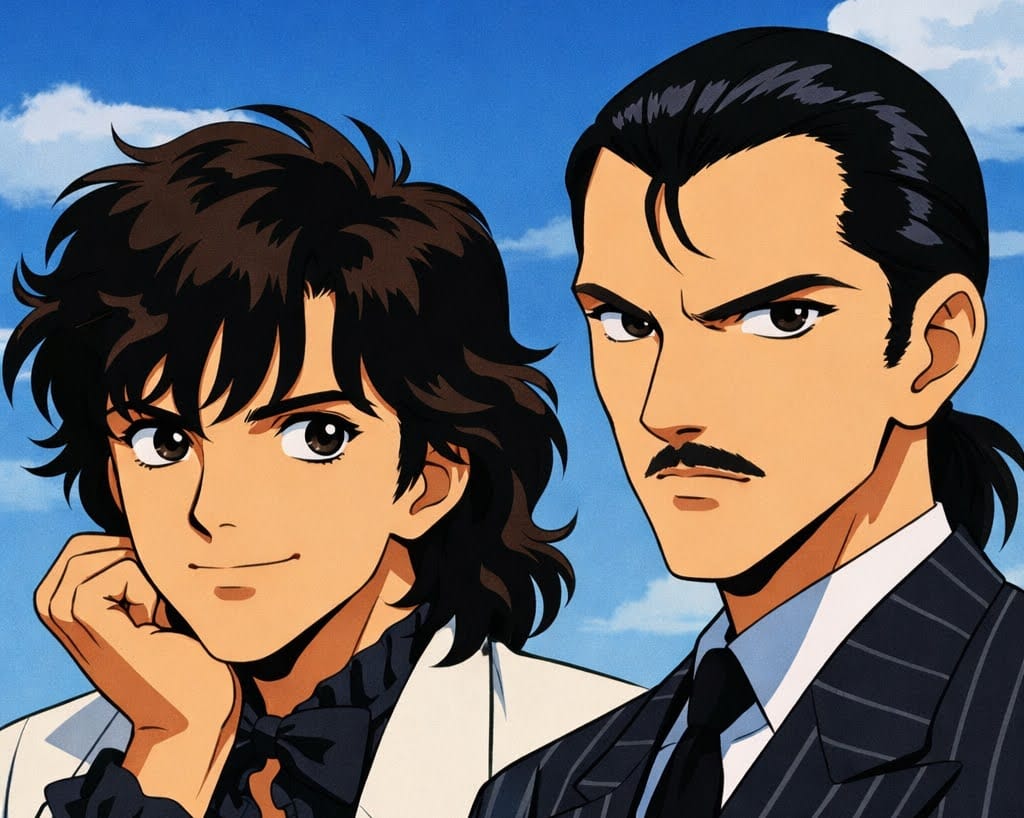
At some point you realize there are records you are supposed to have absorbed by osmosis. Not necessarily loved. Not even necessarily played often. Just... somewhere in the bloodstream of cultural awareness. Alice Coltrane was one of those for me recently. Sparks, it turns out, are another.
I first encountered Ron and Russell Mael in the early 1990s via a Rhino double-cassette retrospective I picked up as a cut-out. The price was low enough to make curiosity painless. The impression it left was correspondingly light. I remember the tapes existing; I do not remember the music making much of an impact.
Somehow — and I genuinely cannot reconstruct the chain of decisions — I ended up with two Sparks albums in FLAC around 2009: Kimono My House and Propaganda. They sat there quietly on the network drive for the better part of fifteen years, occasionally acknowledged but never really investigated.
Then Edgar Wright's The Sparks Brothers documentary arrived, which is essentially a two-hour love letter to Ron and Russell Mael and their improbable fifty-year career. The film doesn't just argue that Sparks are important; it argues that their persistence itself is the achievement. Jane Wiedlin tearing up while describing the brothers simply continuing to make records through the indifferent 1990s is one of the moments that sticks.
Even so, the albums themselves remained largely theoretical in my listening life.
Until this morning.
Thursday began in the usual way: helping Nancy find her keys so she could take Delia out for a walk, sitting through an ITIL change-management WebEx call, pushing a Terraform update that feeds a new Datadog monitor deployment, wrangling laundry, boxing up an Etsy return.
Somewhere in the middle of all that, I finally played Kimono My House.
The first thing that hit me was the bass.
Not the falsetto. Not the theatrical lyrics. Not the reputation. The bass.
I. The Cut-Out Years
Cut-out bins were their own form of curation, even if no one involved would have called it that. Someone at a distributor decided a title hadn't earned its shelf space, slashed the price, punched a notch in the case, and sent it out to die quietly among the remaindered stock at whatever record shop or bookstore chain would take the lot. For the buyer, the transaction was almost frictionless. A dollar or two, maybe three. The risk of disappointment was so low it barely qualified as a decision.
That's how Sparks entered my life. Not through a recommendation, not through radio, not through any deliberate act of seeking out. Just a double cassette in a bin, priced to move, purchased on the slimmest of impulses. The Rhino retrospective did what compilations are supposed to do — it presented the case for the artist across a representative span of years and styles. I apparently found the case unpersuasive, or at least unmemorable. The tapes went onto a shelf and stayed there.
This is not an uncommon story. Most people's relationship with most music is exactly this shallow for most of its duration. We accumulate more than we absorb. Albums pile up as files, as physical media, as vague intentions. The gap between acquisition and genuine listening can stretch across years, sometimes decades. Sparks sat in that gap for me longer than some marriages last.
The 2009 appearance of those FLAC albums on my network drive remains genuinely mysterious to me. That period was the golden age of music blogs and forum recommendations, when the internet was functioning as a vast re-evaluation machine, pulling half-forgotten artists out of obscurity and presenting them to audiences who had either missed them the first time or, in my case, encountered them once and shrugged. Sparks were very much a beneficiary of that moment. Someone, somewhere — a blog post, a forum thread, a passing mention in a comment section — must have planted the seed. But the actual moment of decision is gone. I downloaded three albums by a band I had already forgotten once, and then I proceeded to not listen to them for another fifteen years.
Cultural osmosis is a strange thing. You can carry an awareness of an artist for decades without that awareness ever converting into actual engagement. I knew Sparks existed. I knew Ron Mael had a distinctive moustache and an unsettling stare. I knew "This Town Ain't Big Enough for Both of Us" was a song that existed, the way I know the Chrysler Building exists — as a fact, not an experience. The knowledge was there. The listening wasn't.
II. The Thursday Morning Listen
Working from home has its own particular rhythm, and that rhythm has almost nothing to do with the productivity frameworks people write books about. It is a series of interruptions loosely organized around the idea of getting things done. The dog needs to go out. The change-management call needs a warm body with the camera on. The Terraform configuration needs environment variables that won't break the Datadog deployment. The laundry needs moving from the washer. Nancy needs help finding her keys, which are, as they often are, not where they were last seen.
Into this current I dropped Kimono My House, not as a ceremonial act of listening but as something closer to filling the room with sound. The playback chain was nothing exotic: a ten-year-old Intel NUC with a Realtek onboard audio codec feeding a pair of five-inch Mackie powered studio monitors. Not an audiophile rig by any measure, but the Mackies are honest speakers. Studio monitors are designed to show you what's actually in a recording rather than flattering it, which means that what you hear through them is, for better or worse, close to what's there.
I was not sitting in a darkened room with my eyes closed. I was answering a Slack message about a deployment window while the opening track played. I was refilling my coffee while side two started. The album threaded itself through my morning the way most music threads itself through most people's days — as a presence rather than a focus, competing for attention with the ordinary texture of being alive on a weekday.
And yet things got through.
III. The Bass That Announced Itself
Martin Gordon played a Rickenbacker bass on Kimono My House, and he played it like he wanted you to know he was in the room.
This is not the observation that music criticism typically leads with when discussing Sparks. The usual entry points are Russell Mael's operatic falsetto, Ron Mael's eccentric compositional style, the lyrical wit, the theatricality, the sheer oddness of the whole enterprise. The bass guitar does not normally figure in the opening paragraph. But the bass guitar is what cut through the Wednesday morning noise — through the Slack notifications and the laundry cycle and the hum of domestic logistics — and announced that something worth paying attention to was happening in the room.
The tone is genuinely beefy in a way that seems almost counterintuitive for a band filed under art-pop. You hear descriptors like "theatrical" and "glam" and "clever" and you might reasonably expect the low end to be an afterthought, politely supporting the more interesting things happening in the upper registers. Gordon apparently did not receive that memo. His bass sits high and aggressive in the mix, driving the energy of the record with a physicality that anchors the more frenetic elements — Ron's rapid-fire piano, Russell's acrobatic vocal lines, the busy drums — and keeps the whole thing from floating off into pure whimsy.
What emerges is something close to a trio dynamic, even though Sparks are nominally the Mael brothers' vehicle. Gordon's Rickenbacker isn't just holding down the root notes. It's competing for foreground space with the vocals and the keys, creating a three-way conversation that gives the record a muscularity its reputation doesn't always prepare you for. The Rickenbacker has a specific midrange bite — think Chris Squire in Yes, or Lemmy Kilmister using one as an ersatz rhythm guitar — and Gordon exploits that quality fully. This is a lead instrument disguised as a rhythm section.
His tenure with the band was brief. He was out after Kimono My House, reportedly due to conflicts with the Maels. But his fingerprints on that record are indelible, and what's striking is how clearly they register even through a Realtek audio codec on a morning when you're half-thinking about Terraform modules. If the bass grabs you through an honest set of monitors during a distracted Thursday, it's because someone made deliberate production choices to put it there. That's not your equipment talking. That's the record.
IV. The Companion Album Problem
Two studio albums in a single calendar year. Kimono My House landed in the spring of 1974, Propaganda in the autumn. This kind of pace was not unusual for the era — contractual obligations, lower production costs, and a different industry metabolism made it feasible in ways the modern album cycle simply doesn't permit — but it creates a specific dynamic that recurs across the history of rock music with remarkable consistency.
The pattern works like this: a band's debut, or breakthrough, benefits from a deep reservoir of material. Songs have been written over years, tested in live performance, revised, discarded, refined. By the time they reach the studio, they are battle-ready. The follow-up, arriving months later on the back of sudden success, draws from a much shallower well. The talent is the same. The ambition may even be higher. But the raw material has had less time to mature, and the result is almost invariably a record that is more consistent and less explosive than its predecessor.
The Cars and Candy-O might be the cleanest parallel. The debut was loaded with songs that had been honed across years of gigging in the Boston scene — "Just What I Needed," "My Best Friend's Girl," tracks that became radio staples almost immediately. Candy-O, produced in the slipstream of that success with the same producer, is polished and cohesive but doesn't have an equivalent moment that leaps out of the speakers and demands your attention. It is, to borrow a phrase that kept coming to mind during my own listen, consistently enjoyable.
Propaganda fits this template with an almost textbook precision. The songs are good. The performances are committed. The production is, if anything, more balanced than Kimono My House. But the Rickenbacker is gone. Martin Gordon is gone. The new lineup delivers a more even distribution of energy across the ensemble, which reads as maturity or as polish or as balance, depending on your generosity. What it doesn't deliver is a moment with the immediate force of "This Town Ain't Big Enough for Both of Us" or "Amateur Hour."
This is not a failure. Records that lack obvious standouts sometimes age better than those that spike dramatically around two or three tracks. You return to the singles-driven album for specific moments; you return to the consistent album as a whole experience. But it is a recognizable shape, and hearing it play out across a single morning — one album immediately after the other, separated by a WebEx call and a load of laundry — made the dynamic unusually legible. Propaganda isn't the lesser record. It's the companion record. And companion records live in a specific kind of shadow that has nothing to do with their actual quality and everything to do with sequence.
V. Groucho Marx and the Mael Sensibility
Somewhere between the second side of Propaganda and the Etsy return, a comparison surfaced that I hadn't expected: Groucho Marx.
Look at the song titles across those two albums. "Here in Heaven." "Thank God It's Not Christmas." "Falling in Love with Myself Again." "Never Turn Your Back on Mother Earth." "Something for the Girl with Everything." They have the cadence of a Groucho one-liner — a setup delivered with impeccable timing and a raised eyebrow, funny enough to get the laugh but structured in a way that suggests something more is going on underneath. You can hear Groucho tossing any of them off as an aside while leaning against a mantelpiece, and you can equally imagine them printed on the sleeve of a record that takes itself with complete seriousness.
That duality is the key to what the Maels do, and it's what separates them from other artists who traffic in cleverness. Paul McCartney, for all his gifts, deploys wit as a mode he shifts into and out of. "Maxwell's Silver Hammer" is a playful diversion within a broader palette; it's McCartney amusing himself, and you can feel the wink. The Bonzo Dog Band were fully committed, but committed to the joke as the organizing principle, with genuine musical skill operating in service of comedy. Sparks occupy a different space entirely. The wit and the musical ambition aren't separable layers. You can't peel the cleverness off and find a straight rock band underneath, and you can't dismiss the musical sophistication as a delivery mechanism for humor. The two things are fused.
Ron Mael's stage persona reinforces this. The severe stare, the clipped moustache, the absolute stillness while Russell bounces and preens — it has the same energy as Groucho's painted-on moustache and exaggerated composure between punchlines. Both men perform a kind of controlled absurdity in which the straight face is the thing that makes everything around it stranger and funnier. But Groucho always let you in on the joke. You knew where you stood. With Ron Mael, the contract is less clear. You're laughing, probably, but you're never entirely certain whether you've caught the actual joke or just the surface of one that runs deeper than you can follow.
This is what "committed to the bit" really means when the bit is the entire artistic identity. McCartney can write a vaudeville pastiche and then write "Let It Be." The Bonzos can dissolve into other projects when the joke runs its course. The Maels have been doing this — whatever this is — for over fifty years, and the refusal to break character, or perhaps the fact that there is no character to break, is what makes them unlike almost anyone else in popular music.
VI. Music in the Middle of the Day
Here is the contradiction that lives at the center of recorded popular music, and it has lived there since the technology first made it possible to separate a performance from the occasion of its creation: the same piece of music can function simultaneously as background ambience and as concentrated artistry, and neither function diminishes the other.
A symphony demands your attendance. Jazz in a club presumes at least partial attention. But a pop record is engineered to work at both extremes. It has to be catchy enough to register while you're boxing up an Etsy return and sophisticated enough to reward the close listen through studio monitors. The best pop music doesn't compromise between those two demands. It fulfills both at the same time, which is a genuinely strange achievement that we have largely stopped noticing because it is so woven into the way we live.
Kimono My House proved this to me on a Thursday morning. The bass cut through the noise of a workday without my having sought it out. The production differences between two records announced themselves despite an IT change management WebEx and a team standup sitting in the gap between them. A comparison to Groucho Marx materialized not from scholarly concentration but from accumulated impressions gathered between Terraform deployments and domestic errands. The music was functioning as ambience and as art in the same listening session, and I was functioning as both an inattentive bystander and an engaged listener, sometimes within the same song.
Brian Eno tried to resolve this contradiction by inventing ambient music as a category unto itself — music that could be, in his phrase, as ignorable as it is interesting. But what happened on my Thursday morning was something different and arguably more remarkable. Not music designed for the background, but music that contains enough substance at every level of attention that it meets you wherever you happen to be. Half-distracted by a deployment pipeline? The bass will get you. Momentarily focused between tasks? The arrangements reveal their density. Idly scanning the back cover? The song titles start sounding like Groucho Marx. The record doesn't need your full attention to work, but it doesn't waste your full attention either.
This is not a lesser form of engagement. It might be the most honest one. The reverent listening session — lights down, headphones on, nothing else happening — is a beautiful idea, but it describes approximately none of my actual listening life, and I suspect it describes very little of anyone else's. Music lives in the middle of the day. It lives between the WebEx call and the laundry, between the dog walk and the Etsy return. It gets half your attention and does something with it. Sometimes it does enough that you notice, and sometimes what you notice stays with you, and sometimes what stays with you ends up mattering.
The Mael brothers have spent fifty years making music whether anyone was paying attention or not. They made records through indifference and obscurity and commercial irrelevance, and they kept making them, and the records kept being worth making. Jane Wiedlin choked up about it in a documentary because the simple act of continuing to show up and do the work, year after year, without guarantee of an audience, is one of the most quietly moving things a person can do.
It seems only fair that they finally got a Thursday morning.