Love for Sale
What a record keeps, what it loses, and who carries it forward
A recording outlives the transaction that made it, and goes on passing through the hands of people who had nothing to do with making it. Each handoff keeps something, alters something, and drops something. The musicians, it turns out, have their own accounts of all this.
A long lunch and a record I didn't buy
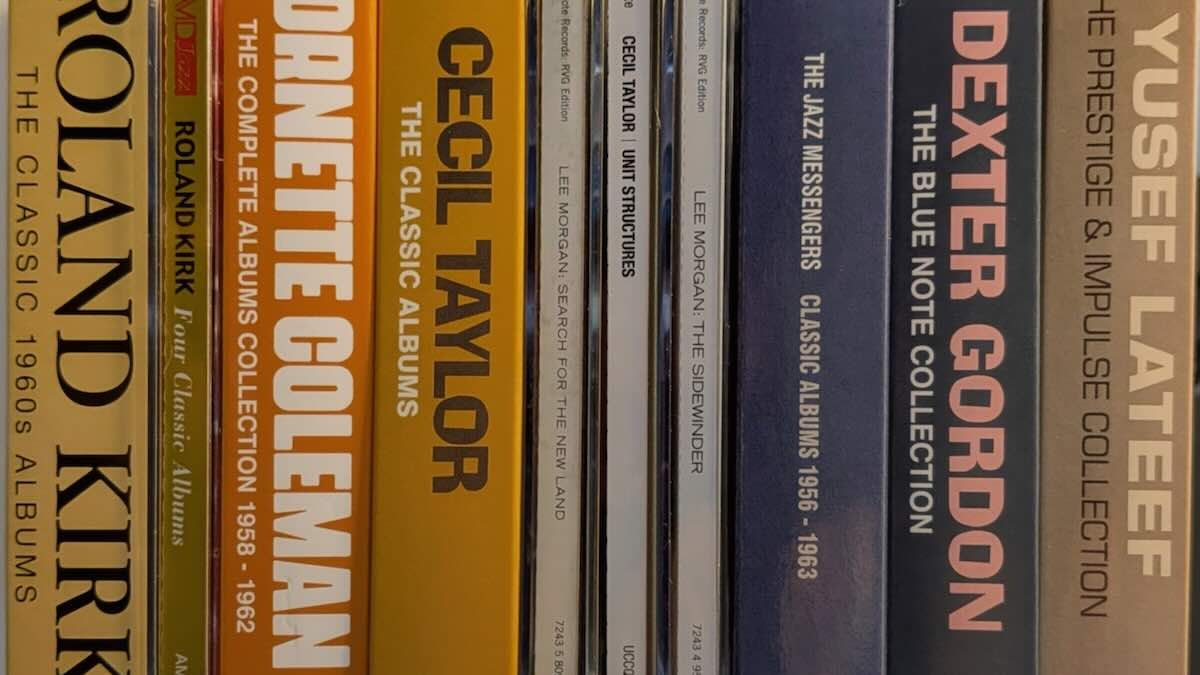
Two CDs came home from the shop on Thursday. Cecil Taylor's Unit Structures, a Japanese pressing from Blue Note's anniversary series, twenty-three dollars. Lee Morgan's Search for the New Land, eight. What stayed in the bin was a brand-new audiophile reissue of Roland Kirk's The Inflated Tear at sixty, still in shrink, which I'd have liked and didn't need, because I have the album already as files I ripped years ago from the library of a college station I was volunteering at.
So I turned it over to read the back, the way you do when you've already decided not to buy something.
The right-hand column isn't a critic. It's Kirk, transcribed from a tape he made describing the record. It opens with him saying that when he dies he wants to be cremated, put in a bag of pot, and smoked by beautiful people who'll hopefully get something out of it. Further down he explains the title: a nurse came to work drunk or high, slipped, and put too much medicine in his eyes, and that's when the tear began.
I stood in the aisle and had the wrong questions. Not what does this cost. Who chose these sentences? How long was the tape? Is it still anywhere?
I owned the music. I had never seen any of this.
What happened, what was recorded, what survived
A tape of unknown length, excerpted once in 1968 by a producer with a sleeve to fill, is a small instance of a general condition.
Mance Lipscomb was a tenant farmer in Navasota, Texas, and sixty-five years old when Chris Strachwitz and Mack McCormick first put a microphone in front of him in August 1960. Forty-five years of a working repertoire exist as what two men caught at the end of it. The Monk quartet with Coltrane played the Five Spot nightly for roughly six months in 1957 and left three authorized studio tracks; the best document of that band is a Carnegie Hall concert the Voice of America taped for broadcast abroad, never heard in the United States, and left uncatalogued among more than fifty thousand VOA tapes and discs until somebody at the Library of Congress noticed a penciled note on a box in 2005.
It would be easy to treat all this as a damaged transcript of some complete musical history. It isn't, because the recording is often the work rather than a report on it. A Love Supreme is a composed suite, not a documented gig. Mingus built The Black Saint and the Sinner Lady out of overdubs and razor-blade splices, so the performance it seems to capture never happened in a room.
The Kirk jacket makes the distinction concrete. It documents its own manufacture: engineer, producer, and a paragraph promoting Atlantic's new CSG Stereo process, a mono-compatibility system now generally understood to degrade whatever passes through it. The 2026 reissue's own account says pure analogue from the master tapes to the cutting head. Two descriptions of one signal path, fifty-eight years apart, both supplied by parties with something to sell.
A recording can keep the performance intact and lose nearly everything that surrounded it.
When the musician speaks
Kirk reaches me through sentences somebody picked for a record jacket. Cecil Taylor reaches me through an interview the composer and improviser Miya Masaoka published in the San Francisco Bay Guardian in October 2000, which is now on her website because she put it there.
Masaoka asks like a practitioner. Her questions are about physicality, choreography, the leap a dancer makes. Taylor keeps declining the premises.
Asked whether he was ever tempted to play music as a commodity, whether his vision was grander than that, he says it wasn't all that, believe me, and describes a club on 145th Street: a bandstand six feet off the floor, an upright with eight dead notes, a stool sitting inches from the edge so you had to keep checking behind you. Nine at night until four in the morning, fifteen minutes off each hour, eight dollars, playing standards. He'd be content never to hear "Stardust" again.
Asked why Coleman's 1959 arrival got the attention while he was ignored, he doesn't reach for the critics or the market. He says part of it was his own doing: people in the industry sent word that they wanted to meet him, and he wouldn't meet people he considered frauds. Then three words — they found Ornette. The published interview brackets out the names.
Asked about his pianistic language, he starts talking about bridges. That the plan of a bridge interests him more than a musical score. That he works a section by playing it over and over until, if he's lucky, he makes a mistake that takes him somewhere he hadn't imagined.
None of which arrives unmediated. Masaoka's own introduction calls him a shaman unleashing pianistic terror. The piece was edited, printed in a weekly, and preserved by its author. And Taylor is an interested witness about Taylor: I refused to play ball is a flattering account of one's own neglect, which doesn't make it untrue.
First-person testimony doesn't remove interpretation from the chain. It adds the musician to it as a participant, which is a different thing from being the object everyone else is handling.
The work of keeping things
Strachwitz recorded Lipscomb when nobody else would, founded Arhoolie in 1960 to release that record, ran the label for fifty years and made most of its four hundred albums himself. In 2016 the catalog was bought and given to Smithsonian Folkways, which is obliged to keep it available. He also owned the masters, and the owning is what made the rest possible.
Joel Dorn produced seventeen albums with Kirk and says Atlantic in those years let a producer they trusted do essentially whatever he wanted. He also repeats, without being asked, what Kirk's first wife told him years later: that he'd been the white guy who got Kirk through the door. He agrees that in the beginning she was right. And when he reaches for what made Kirk singular, he reaches for the blind man playing several horns at once, which is how the novelty reading survived as long as it did. It wasn't only coming from people who disliked him.
Packaging belongs on this list too, because it is editorial work and not a container. Take Off restored Miles Davis's Blue Note albums to sequences that hadn't existed since the early fifties. Miles '56 dissolves four albums back into the order the tape rolled. A session Taylor led in 1958, issued as Hard Driving Jazz under his name, returned years later as Coltrane Time because by then the sideman was the name that moved.
And there is a kind of labor the credits barely admit. Dick Griffin made his recording debut on The Inflated Tear, and as a member of Kirk's band he notated and transcribed the music for a leader who couldn't write it down. The 1968 jacket spells him Griffith. The reissue fixed it fifty-eight years later.
None of them need sorting into heroes and villains. The useful questions are what each one added, what each controlled, and what fell out at the handoff.
Love for sale, and the price of keeping it
The receipts, then. Five dollars for a Fred McDowell disc that's in print. Eight for an Arhoolie Lipscomb that isn't. Twenty-six for a numbered Rhino edition long out of production. Thirty for eight Ornette Coleman albums on four discs, legal because a 2011 European directive drew a permanent line at the end of 1962 and left everything published before it in the public domain. Twenty-three for a single licensed Taylor album from the protected side of that line. Sixty for the Kirk I left in the bin. Nothing at all for the files.
Each is a different transaction containing much the same music. The secondhand purchases are where the money stops in the shop: first sale, no royalty, no mechanical. The public-domain box still owes publishing, because compositions run on a life-plus-seventy clock regardless of what happened to the recording. The college-radio rip owes nothing — though the station's broadcasts were themselves licensed, so the music generated payment every time it went out over the air and none at all when I walked off with a copy.
Which is where the Porter song earns its place. "Love for Sale" entered the American public domain in January 2026, ninety-five years on. Taylor recorded it twice inside that cheap box, at Newport in 1957 and at a New York studio in 1959, three Porter tunes with a trio on one side and his own compositions with a quintet on the other. The man who'd had enough of standards, making a standards record.
The composer-performer distinction matters more than I first thought. Coleman and Taylor wrote most of what they recorded, so their estates can collect as composers even where the recording rights have lapsed. The person with nothing coming is the player who wrote none of it, hired for an afternoon and paid once. And an obligation owed is not a payment demonstrably made.
Taylor's eight dollars isn't there to be set against the price of a used CD. It's there because the labor happened under conditions, and the conditions aren't recoverable from the object.
The question stops being why a great performance costs so little. It becomes why I'd expect the price of a surviving copy to report anything about how its makers and keepers were paid.
What the listener carries forward
This account came from record jackets, discographies, a German reissue label's product page, a composer's personal website, a government archive's press release, and a nonprofit jazz site's excerpt of a university press book. It also came from a long conversation with an AI, which several times told me a confident thing that turned out to be wrong and had to be walked back. One of those sites notes in its footer that it has been human-produced and AI-free since 1999. Fairly said.
I'm not standing outside any of this. A radio volunteer takes a rip off a station shelf. Years later he picks up a record he won't buy, reads the back, photographs it, looks up an interview a composer posted twenty-six years ago, and starts assembling another account of a man he never met. None of that required owning a master, and none of it generated a payment. It still moved something along.
I don't think this obliges anyone to become an archivist. Most people want to hear the music, which is the correct reason to buy a record. But ordinary curiosity turns out to be one of the forces keeping a cultural object legible, and it operates without anybody deciding that it should.
Which brings it back to the jacket. Something of Kirk survived because Dorn held a microphone up to him and a designer found room for it. What got printed wasn't the whole tape. I still haven't heard the rest. Maybe it exists in a vault somewhere; maybe it was taped over; maybe it would change what I think of him, or maybe it would only show that whoever edited it picked the best lines, which is its own kind of information.
Taylor, asked about his own voice, said that without Ella Fitzgerald and Monk and Fats Waller there is no Cecil Taylor, that it's a line, that it comes from someplace. He was more interested in how a bridge gets built than in how a score gets written — the conceiving, the engineering, the work of joining two places that were previously apart.
Nobody owns that process end to end. You take delivery of a part of it, and you pass along a part of it, and what you hand on is never quite what you received.