Kestrel-class Short-Haul Transporter
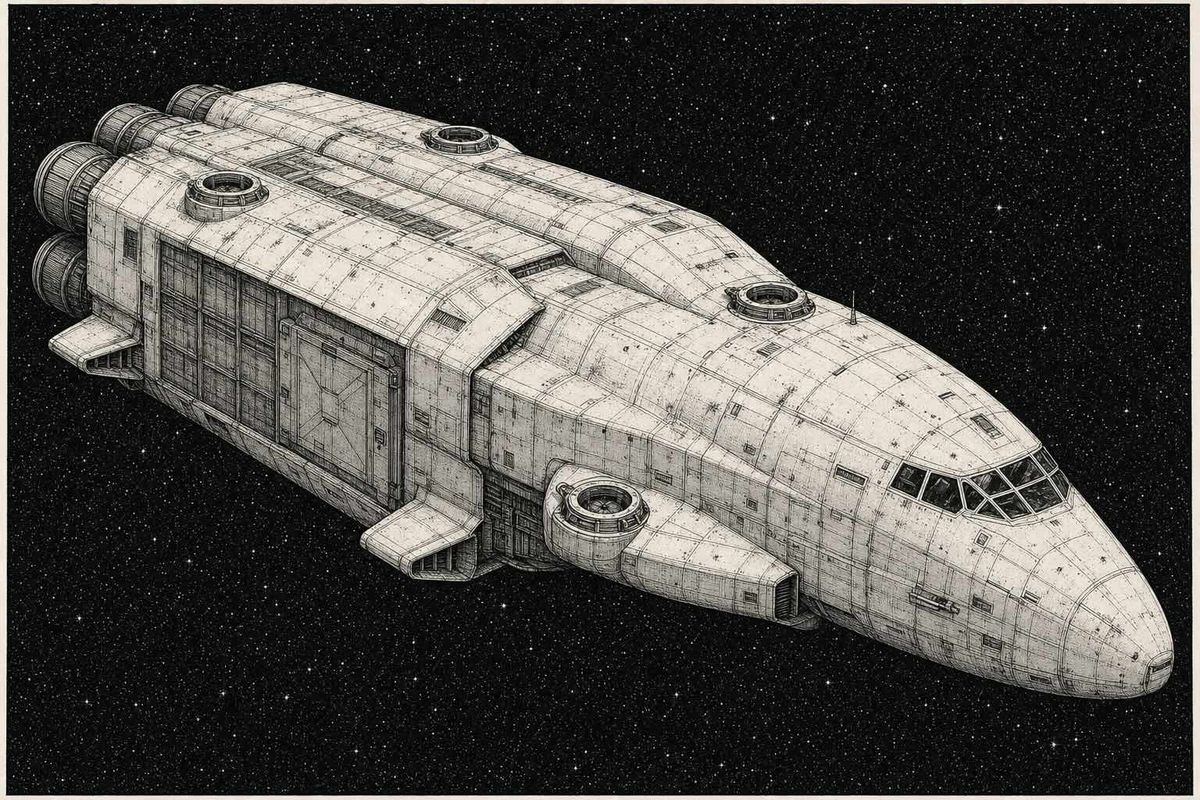
Designed under Classic Traveller Book 2 (1981) rules.
Paragraph Description
Using a custom 1,000-ton hull, the Kestrel-class short-haul transporter is a streamlined, cargo-first jump-1 merchant built to move as much freight as possible between neighboring systems one parsec apart. Its commercial purpose is deliberately narrow: repeatable point-to-point industrial lift between developed endpoints, with direct planetary landing or gas-giant refueling available when the route demands it.
The Kestrel mounts jump drive-F, maneuver drive-F, and power plant-F, producing jump-1 and 1-G performance. Fuel tankage of 110 tons supports one jump and four weeks of power-plant operation. A Model/1 computer is fitted adjacent to the bridge. The ship has five hardpoints but begins service without turrets or weapons. Five tons are reserved for future fire-control installation, following the same growth-margin logic used by Book 2's merchant designs.
The minimum crew is five: pilot, navigator, two engineers, and medic. Each has a private stateroom. With no passenger accommodations, no small craft, and no installed weapons, the Kestrel retains 779 tons for cargo and payload. In normal service, this is an industrial hauler: containerized machinery, bulk feedstock, reactor components, agricultural equipment, refinery products, habitat sections, or any other cargo whose value lies in crossing a parsec on a reliable schedule. Streamlining permits direct service to surface ports and wilderness refueling where permitted, but its primary role is operational resilience rather than glamour.
The hull's enormous hold is also its ambiguity. A lawful Kestrel is a boringly useful merchant. The same form could be converted, outside the base commercial configuration, into a Q-ship, small-craft tender, mobile workshop, disaster warehouse, pirate depot, clandestine production vessel, or other specialized platform. Those conversions are not part of this design; they are what its cargo-forward form makes possible.
Statistics
| Hull | 1,000 tons, custom |
| Minimum technology level | TL10 (drive-F components) |
| Performance | Jump-1, 1-G, Power plant-1 |
| Fuel | 110 tons (100 jump + 10 power plant) |
| Computer | Model/1 |
| Crew | 5: pilot, navigator, 2 engineers, medic |
| Staterooms | 5, single occupancy |
| Hardpoints | 5, unarmed; 5 tons reserved for future fire control |
| Small craft | None in baseline configuration |
| Streamlined | Yes; fuel scoops included |
| Nominal cargo / payload | 779 tons |
| Cost | MCr254.520, including 1% architect's fee |
| Build time | 30 months |
Tonnage and Cost Budget
| Component | Tons | MCr |
|---|---|---|
| Hull, 1,000 tons, custom | — | 100.000 |
| Jump drive F | 35 | 60.000 |
| Maneuver drive F | 11 | 24.000 |
| Power plant F | 19 | 48.000 |
| Bridge (2%, minimum 20 tons) | 20 | 5.000 |
| Computer Model/1 | 1 | 2.000 |
| Fuel (0.1 × 1,000 × 1 + 10 × 1) | 110 | — |
| Staterooms ×5 | 20 | 2.500 |
| Hardpoints ×5 | — | 0.500 |
| Fire-control growth margin | 5 | — |
| Streamlining | — | 10.000 |
| Total installed | 221 | 252.000 |
| Cargo / payload hold | 779 | |
| Architect's fee (1%) | 2.520 | |
| Total | 254.520 |
Crew Manifest
| Position | # | Basis | Monthly salary, skill-1 |
|---|---|---|---|
| Pilot | 1 | One per ship | Cr6,000 |
| Navigator | 1 | Ship over 200 tons | Cr5,000 |
| Engineer | 2 | 65 tons of drives ÷ 35, rounded up | Cr8,000 |
| Medic | 1 | Ship of 200+ tons | Cr2,000 |
| Total | 5 | Cr21,000 |
Operating Notes
Commercial doctrine
The Kestrel is not a planetary-economy replacement for oceanic bulk shipping. Its 779-ton hold is substantial by Book 2 merchant standards but small beside modern terrestrial container traffic. It earns its place where jump-capable, one-parsec lift is valuable: neighboring-system industrial supply chains, frontier construction, controlled hazardous cargo, irregular high-mass lots, and routes for which delay or multiple intermediate transfers cost more than the jump.
Empty hardpoints
The five hardpoints are installed in the hull and cost MCr0.500. No turrets, weapons, or gunners are included in the baseline. Five tons are deliberately left as fire-control growth margin; a later armed refit can fit turrets without taking additional cargo volume beyond the turret and weapon costs themselves.
A strictly maximum-payload civilian operator could omit the growth margin and carry 784 tons instead. The class standard chooses 779 tons as the modest price of future optionality.
Streamlining
Streamlining costs MCr10.000 but does not consume cargo tonnage. It permits fuel scoops and supports direct surface operations, allowing the Kestrel to reach industrial ports, remote collection sites, ocean platforms, and secondary facilities rather than behaving only as an orbital terminal-to-terminal barge.
What the hold permits
The 779-ton hold is intentionally undifferentiated in the base design. It may be fitted with container racks, bulk tanks, cargo pallets, modular workshops, relief stores, or specialized loading fixtures as cargo rather than permanent ship systems.
A Q-ship or tender conversion is possible as a campaign or referee-level adaptation, but not automatic under Book 2. Raw tonnage might admit three 200-ton SDBs or a fighter squadron, yet a functioning internal hangar also needs doors, handling gear, fuel and maintenance facilities, launch/recovery clearances, crew, and a revised cargo arrangement. Such a vessel has become a different class with a different doctrine.
Design History
- Start with a 1,000-ton hull and the smallest legal jump-1 / 1-G / power-1 drive set: F/F/F.
- Select a custom hull so the drive section is sized to the actual 65 tons of machinery rather than retaining unused standard-hull engineering volume.
- Add minimum required bridge, Model/1 computer, and 110 tons of fuel.
- Add the five-person minimum crew and five single staterooms.
- Fit five unarmed hardpoints and reserve five tons for a potential later fire-control installation.
- Add streamlining for direct planetary operations and fuel-scoop flexibility.
- Assign the remaining 779 tons to cargo and payload.
Referee Hooks
- A routine Kestrel has disappeared between two systems whose governments both insist the cargo was mundane industrial equipment.
- The cargo manifest says “prefabricated refinery modules”; a port inspector notices that the sealed crates have military-grade environmental shielding.
- A shipping consortium has quietly ordered a dozen Kestrels, too many for the declared route. Rival firms want to know what new industrial corridor is being prepared.
- A legitimate Kestrel crew discovers its charterer has replaced standard cargo racks with hangar fittings. The vessel is about to become someone else's private navy.
- A pirate syndicate has acquired a derelict Kestrel. The empty hardpoints and huge hold make it more useful as a mobile base than as a raider—unless someone catches on before the conversion is complete.