Giant Robots, Correctly Sized
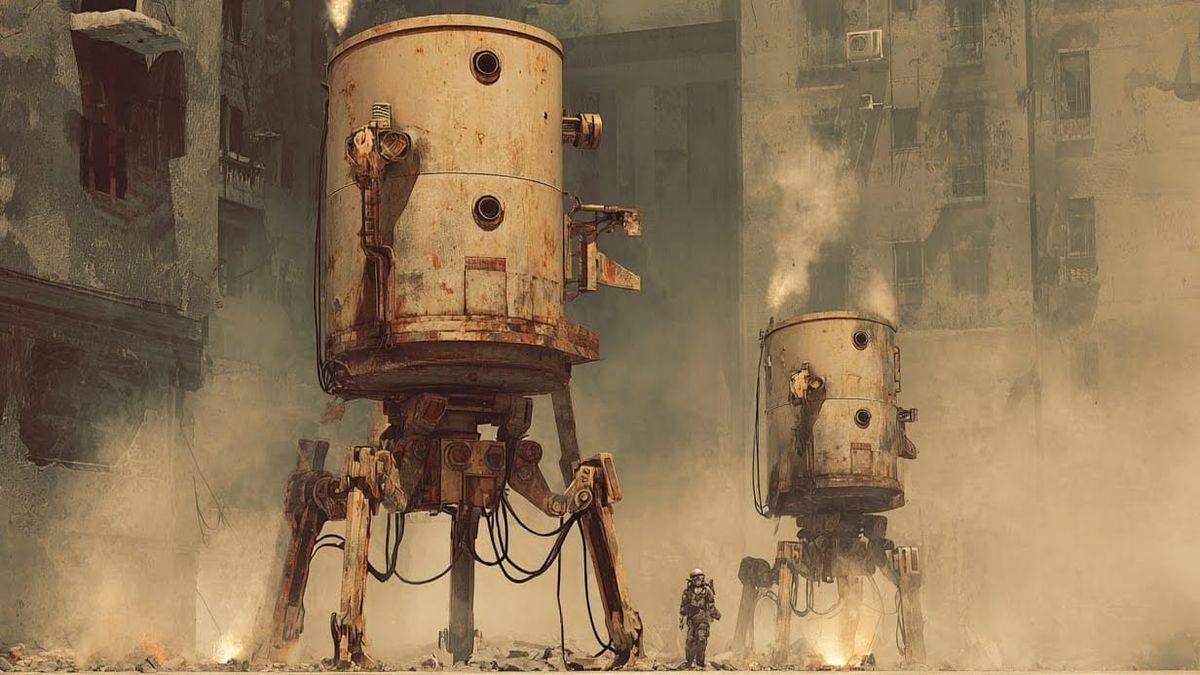
Notes on a Skirmish Game I Haven’t Played
I. The Confession
Here is my long meditation on the cultural ecology of a robot skirmish game I have not played.
I have rolled zero dice. I have moved zero miniatures. I have not tested balance, probed edge cases, or stress-tested faction interactions. No beer glasses have stood in as arcologies. No salt shakers have cooled imaginary reactors. This is not a review.
This is an architectural critique, but hopefully a gentle one.
It is possible to walk into a restaurant and know, before tasting anything, whether the place intends to annex your evening. You can see it in the menu length, the lighting, the table spacing, the way the room either invites you to sit or demands that you commit. You can tell when a place wants to become a recurring expense in your life.
Flames of Orion, as read from its rules, does not feel like annexation. It feels like proportion.
That is what this essay is about: not whether the soup is good, but whether the bowl is the right size.
II. Hobby Gravitational Fields
Tabletop games, like celestial bodies, possess mass.
Some are moons. You can carry them in a tote bag, set them down anywhere, and leave without noticing the strain. Others are gas giants. They arrive in boxes the size of small guitar amplifiers and expand outward into shelves, storage solutions, expansion packs, faction codices, organized play kits, and eventually a subtle reconfiguration of your living space.
This is not a moral failing. It is physics.
Big games promise depth, spectacle, immersion, community. They also demand table real estate, storage concessions, and attention over time. The more polished the artifact, the more likely it is to come with orbiting bodies: expansions, campaigns, accessories, lore bibles, competitive metas. You do not simply purchase them; you enter their gravitational field.
At a certain point — and this point varies by temperament — the appeal shifts. You begin to notice the weight. Not just financial weight, though that’s part of it, but cognitive and spatial weight. Setup time. Tear-down time. The quiet pressure to justify the footprint.
Flames of Orion does not read like a gas giant.
It reads like something that can exist without rearranging your furniture.
That difference — between a system that colonizes and one that coexists — is subtle on the page. But it is legible.
And legibility, in 2026, counts for something.
III. The Chassis
From the page alone, Flames of Orion reads like a chassis.
Not a cathedral. Not a thesis. Not a lifestyle brand. A chassis.
The core resolution is clean. The mechanics appear to favor clarity over ornament. There is friction where there should be friction — heat accumulation, positional tension, risk management — but no ornamental excess. The rules do not sprawl in search of realism. They outline a loop and trust it.
The HEAT mechanic, in particular, feels less like a gimmick and more like a throttle. Push harder, generate more output, incur more cost. That relationship is legible immediately. It suggests pacing without requiring a dissertation to interpret it.
Movement is abstracted enough to avoid measuring-tape fetishism. Zones do the work that grids and rulers often overperform. It implies that salt shakers and folded paper can stand in for terrain without breaking the illusion. It implies that the game can function in a pub as easily as in a dedicated hobby room.
Perhaps most notably, nothing in the rules insists on allegiance.
There is no demand that you buy into a sprawling canon. No implication that the “real” experience requires a particular SKU. No suggestion that your enjoyment depends on expanding outward. It appears content to exist at the scale it was designed for.
That posture matters.
A system that trusts its own loop feels different from one constantly gesturing toward future supplements. Orion does not read like a gateway to something larger. It reads like something complete.
Whether it plays brilliantly or merely competently is a separate question. What is visible on the page is structural modesty paired with mechanical intent.
It does not insist.
IV. Burden
It is possible to design a chassis and then layer commentary on top of it.
It is also possible to design the commentary first and let the mechanics serve it.
Some of my own past designs - Blue + Red = Dead and Mecha Borg - have come pre-loaded with escalation. Pressure was not optional. Systems accumulated strain whether players wanted them to or not. Individual heroics were permitted, but they were structurally undermined by larger forces. The mechanics functioned, but they carried an argument in their bones.
They were essays with stat blocks and dice rolls.
There is nothing wrong with that. A system that enforces its thesis can feel bracing. It knows what it wants to say, and it ensures that you hear it.
But enforcement is still weight.
Flames of Orion does not appear to arrive weighted in that way. It contains tension without insisting on tragedy. It models heat, risk, and tactical consequence, but it does not preload inevitability. It can host commentary. It does not compel it.
That distinction — between capacity and compulsion — is what makes it feel unburdened.
An unburdened system can still be violent. It can still be ugly. It can still spiral, if the table chooses. But the spiral is not factory-installed.
That difference may not matter to everyone. For those of us who have built games with the escalation embedded from page one, it is noticeable.
And noticeable can be enough.
V. Access Without Annexation
Accessibility is often framed as price.
Free PDF. Low cost of entry. No required expansions.
That matters. But price is only one axis.
There is also physical footprint. Cognitive load. Ecosystem expectation.
A game can be inexpensive and still demand annexation. It can require lore knowledge, faction buy-in, campaign continuity, meta awareness. It can quietly imply that the “real” experience happens only after sufficient accumulation.
Flames of Orion does not read that way.
The rulebook establishes kitbashing as a legitimate aesthetic — from that, I posit that it appears comfortable with substitution. Counters instead of miniatures. Salt shakers as cooling towers. Beer glasses as arcologies. A pub table can become a battlefield without apology.
That posture is significant.
It suggests that the game does not require a dedicated room, a 3D printer, or a shelving strategy. It can coexist with other hobbies rather than expand until they are displaced.
This is not anti-production. It is anti-annexation.
An anti-annexation design does not attempt to colonize your shelf, your budget, or your calendar. It offers a loop and leaves the rest to you.
For players who have stepped away from splat books and faction codices, that can feel less like austerity and more like relief.
Relief, in a hobby built on accumulation, is not trivial.
VI. The Double Edge
Elasticity is not virtue by default.
A system that does not enforce tone also does not prevent it from drifting. If a table wants spectacle without reflection, it can have it. If it wants brutality without consequence, the rules are unlikely to intervene. Nothing in a compact chassis guarantees ethical play.
No rulebook can fully regulate the culture that surrounds it. Tone emerges from the table: from the participants, from what they bring with them, from what they choose to emphasize or ignore. A minimalist system simply makes that relationship more visible.
Flames of Orion appears to trust the table to decide what kind of story it is telling. That trust is generous, but it is also neutral. It does not steer. It does not correct. It does not warn.
Some players will see that neutrality as a flaw. Others will see it as freedom.
The important distinction is that neutrality here is structural, not ideological. The rules do not sermonize. They do not congratulate or condemn. They provide a framework and step aside.
Whether that framework becomes catharsis, critique, competition, simple diversion, or even malicious mischief depends less on the chassis and entirely on the room. The rulebook has no opinion about which room it's in.
VII. The Bias Check
This is anything but an objective analysis.
My attraction to a system like Orion says something about me.
I prefer compression to sprawl. I distrust spectacle's gravity. I am suspicious of games that arrive with orbiting bodies already in tow. I like chassis more than cathedrals. I like bass lines more than guitar solos.
There is likely a romanticization of the small in that posture. Small systems feel virtuous. Modest footprints feel principled. That may be bias rather than insight.
It is also simply temperament.
After years of shelves, bins, codices, and expansions, the idea of a system that does not demand allegiance is appealing. Not because it seems morally superior, but because it feels proportionate to me.
The fact that I have not played Flames of Orion only sharpens that reality. What I am responding to is not performance data. It is posture. It is scale. It is the absence of insistence.
Lenses are not neutral. They are accumulated.
These are mine.
VIII. The Return
So this concludes my long meditation on the cultural ecology of a robot skirmish game I have not played.
I cannot tell you whether the dice sing or stumble. I cannot tell you whether the HEAT mechanic produces nail-biting tension or polite arithmetic. I cannot tell you whether the factions are balanced, or whether that hypothetical third session reveals an exploit lurking beneath the surface.
What I can tell you is that the artifact reads as correctly sized.
Its ambition matches its footprint. Its rules appear proportionate to its scope. It does not gesture toward inevitable expansion, nor does it posture as definitive. It offers a loop and stops. In a hobby culture where escalation is often assumed, stopping is a design choice.
Perhaps I will pick up a copy from the local shop, if they have any left. And it will sit beside my box of unpainted miniatures. Perhaps it will never see a table at all.
And that is absolutely fine.
Because sometimes the value of a thing is not that it demands your life, but that you quietly and gently accommodate it.
Flames of Orion, from the pages alone, appears to understand that.
Correctly sized.