Catastrophe As a Play Stage
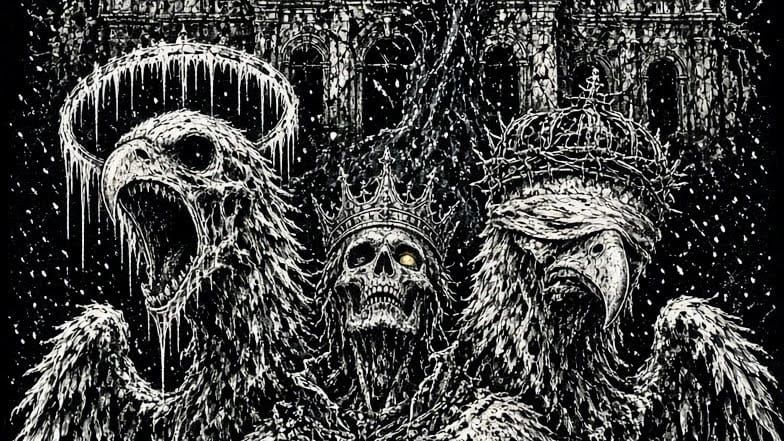
The other day, while reading Antony Beevor’s Rasputin, I had the thought that the last days of Imperial Russia would make an excellent MÖRK BORG setting.
This is, admittedly, not the most dignified response to civilizational collapse.
There was something immediately legible about it, though. The weak autocrat. The hated foreign-born empress. The hemophiliac heir. The peasant mystic with bad grooming and worse boundaries. The secret police. The revolutionaries. Bread lines. War. Rumor. A bureaucracy that seems to operate principally by moving responsibility from one desk to another until nobody remembers who owned it.
You barely need to add the apocalypse.
My previous exposure to Rasputin was not exactly scholarly. We watched Nicholas and Alexandra in school, and the one thing I remembered for decades was Tom Baker, pre-scarf, giving those eyebrows a tremendous workout. I had actually misremembered him as Colin Baker until recently, which tells you roughly how much else survived the lesson.
The broad outline remained: doomed family, Siberian holy man, revolution, basement.
Beevor made the whole thing much more crowded.
I first encountered him through Stalingrad, followed fairly quickly by Berlin, and his way of moving through history has stuck with me ever since. From high enough up, a campaign begins to look like weather. Fronts push against fronts. Salients form. Railways become pressure systems. Encirclements close. Food and ammunition move like precipitation, except when they don’t.
There is a certain poetry to that altitude. Then somebody is in a cellar.
This has become one of the ways I understand history now: the weather is real, but eventually the weather becomes a person deciding who gets the food.
This would probably have helped my high-school self, who tended to encounter history as a pile of names, dates, treaties, battles, and dramatis personae presented before I had any reason to care about any of them. At some point, something embarrassingly simple clicked for me: a lot of history is people doing asshole things to each other.
I don’t mean that as a reduction. Quite the opposite. Once I could see an actual person at the end of “policy,” the catalogs started becoming legible. Somebody signed that. Somebody knew it was a bad idea. Somebody followed the order anyway. Somebody decided the convenient cruelty was necessary. Somebody later explained why nobody could possibly have done otherwise.
Apparently I was fine with catalogs after all.
I say this because, many years later, I somehow consumed an indecent number of pages of the Horus Heresy, from “I was there the day Horus slew the Emperor” all the way to The End and the Death, Part III. This is not something one does accidentally. At some point you have to notice that you own enough books about fictional logistics to load a small truck.
The irony only occurred to me recently.
The Heresy is everything that used to put me off about history industrialized into entertainment: campaigns, worlds, dates, factions, military hierarchies, names that require glossaries, battles whose significance depends on remembering three previous books.
But it keeps dropping back into rooms.
A legion becomes a captain deciding whether another captain is still his brother. Imperial policy becomes a conversation. Myth becomes an order someone obeys because the alternative is worse. The giant machinery repeatedly resolves itself into people doing things to one another.
Then the camera rises again, and those decisions become weather. Which is probably why the Russian material landed so easily in the first place.
There is a Romantic “Russia” already sitting in the Western cultural warehouse, assembled long before any particular game designer gets there. Endless plains. Winter as personality. Holy peasants. Decadent courts. Vast suffering. Dostoevsky making murder into theology. Tolstoy turning campaigns into cosmology. Gogol allowing an overcoat to become an existential predator.
Once that machinery is in your head, Rasputin hardly needs an introduction, as he arrives pre-mythologized.
And that is where WITHERCROWN started to become more interesting to me than the original joke.
The easy version was obvious: Rasputin as MÖRK BORG boss monster. The bleeding heir as occult portal. The empress as fanatic. The empire collapses because something is rotten at the mystical center.
Beevor keeps making that explanation harder to sustain.
The catastrophe is not less dramatic when you start paying attention to officer morale, train schedules, grain distribution, cabinet instability, rumor, policing, legitimacy, and the accumulated memory of previous failure. If anything, it gets stranger. There is no single lever.
There are hundreds of people pulling different levers, and so the setting started changing.
The starets stopped being the hidden keystone. If he dies, reality does not immediately collapse because the wizard has been removed. Instead the empress panics. His enemies overreach. The police start arresting people connected to the idea of the murder. Contradictory rumors reach different regiments. Relics begin circulating. Everybody who already had a plan suddenly has an event.
The apocalypse moves sideways.
The introductory scenario ended up being set in a government building. No demons. No undead. No giant mystic entering through the double doors. Clerks. A porter with a numbered logbook. A telegraphist reading messages aloud. A secretary burning correspondence. A young woman trying to retract testimony she gave under pressure. A file split among different offices because that is how the bureaucracy works.
“The building is not haunted. It is staffed.”
It's a comic cheap shot, and it also seemed to locate the setting more accurately than anything else had. Which is where the uncomfortable part arrives.
A civilizational catastrophe is not neutral raw material. Turning it into a stage for play can become grotesque very quickly. MÖRK BORG is particularly good at making horror stylish, which means it is also particularly good at turning suffering into furniture if you are not paying attention.
I don’t think the answer is to pretend the game isn’t play.
It is. But play has one useful property: somebody has to do something.
A player cannot remain at the altitude of “the regime has lost legitimacy.” They have to decide whether to steal the file. Forge the pass. Free the prisoner. Shoot the guard. Abandon the witness. Save the child.
The empire still falls. The Calendar still completes. History from altitude looks like weather. History from the room looks like Tuesday.
And somewhere between those two views, somebody stamps the form.