Be Seeing You!
A TiGGR Scenario About Routine, Surveillance, and the Cost of Staying Livable
Cultural Touchstone: The Prisoner (1967–68)
Players: 2–5 | Playtime: 30–45 minutes | Components: 2d6, pencil, paper
Requires the TiGGR core rules
THE PREMISE
You are not Number 6. You are not Number 2. You are not Rover. You are nowhere near the levers of power that keep replacing both. You are the people who live here.
The Village is your home. You did not build it. You do not run it. You cannot leave it. But you have learned its rhythms, earned its small comforts, and carved out a life inside its walls. You know which cameras to avoid, which smiles to return, which questions to deflect. You have a routine. The routine keeps you safe.
And here is the thing nobody warns you about: the Village is not miserable. That would make things simpler. The tea is good. The paths are tidy. The sea views are real. The brass band plays on schedule and it sounds fine. Comfort is one of the ways the Village keeps you—not through constant overt terror, but through the management of pleasantness. You are not just protecting yourself from punishment. You are protecting the only livable world you have.
Now a newcomer has arrived—volatile, paranoid, charismatic—and is already pulling at threads. A new Number 2 has arrived too, eager to prove themselves. Between them, the fragile equilibrium of your daily life is about to be tested.
This is not a scenario about escape. It is not a scenario about resistance. It is a scenario about what forms of life become possible inside total administration—and what it costs to maintain them.
The villagers are not chess pieces. They are the board.
TOUCHSTONE
The Prisoner (ITV, 1967–68). A surreal thriller set in a coastal settlement where a former intelligence agent, designated Number 6, is held captive alongside other residents. The Village offers every amenity and no exit. Authority rotates through a series of administrators, each designated Number 2. Enforcement is pervasive, polite, and occasionally violent. The show frames the Village through the rebel's eyes. This scenario inverts that perspective entirely.
You do not need to have seen the show to play. The premise is self-sufficient: a beautiful, surveilled village you cannot leave, a newcomer who keeps trying, and the question of how you live in the meantime.
SCENE & GOAL
Setting
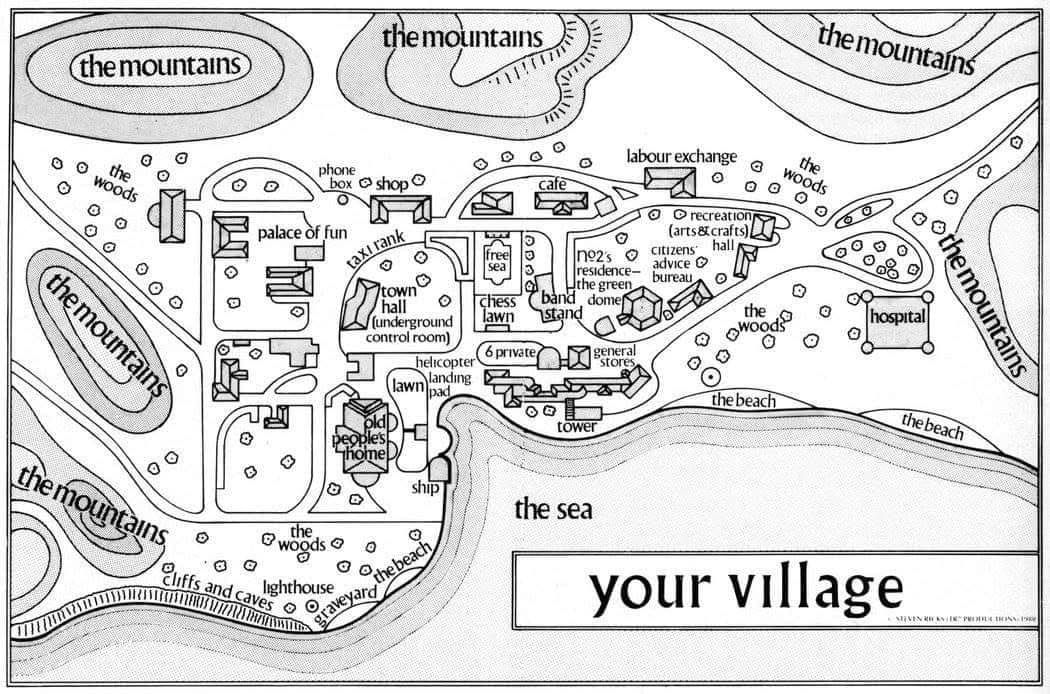
The Village. A coastal settlement of manicured lawns, pastel buildings, and relentless pleasantness. Somewhere between a resort town and a terrarium. Mountains ring the landward sides. The sea fills the rest. Everything you need is provided. Nothing you want is permitted. Today is beautiful, like every day.
Key locations: the Town Hall (underground control room beneath), the Green Dome (Number 2's residence), the hospital, the general stores, the band stand, the chess lawn, the café, the old people's home, the lighthouse, the beach, the graveyard, cliffs and caves.
Goal
Survive the week. Keep your heads down. Maintain your routines. Protect what little autonomy you've carved out. Make it to next week with your lives, your minds, and your small comforts intact.
Each player begins the scenario with a routine privilege—a small, banal comfort that depends on continued compliance. These are the stakes:
- Tea rations from the general store (specific blend, specific time)
- Seaside walking access during the quiet hour
- Visiting hours at the old people's home
- A preferred shift at the café
- Access to the library's restricted shelf
- Permission to play in the brass band
- A prescription from the hospital dispensary
The more banal and precious the comfort, the better. Losing it is not catastrophic. That is what makes the threat effective.
FACTIONS
The Administration
Body 0 | Mind 2 | Charm 1 | HP 5 "Smile and Comply": +1 Charm when issuing polite orders
Number 2 and the apparatus—surveillance cameras, Rover (a suffocating weather balloon that pursues runaways), the hospital's "treatments," the control room beneath the Town Hall. They rotate. They are under pressure too. They need results from Number 6, and collateral damage among villagers is acceptable.
The Current Number 6
Body 2 | Mind 1 | Charm 0 | HP 5 "I Am Not a Number": +1 Body when attempting escape
Driven, reckless, convinced everyone is either a warder or a coward. Will try to recruit you, use you as a distraction, or blow your cover without a second thought. From the outside, Number 6 is the heroic truth-teller. From inside the social fabric, they are also the person who keeps turning your manageable captivity into unmanageable crisis. They are not wrong, exactly. But they are expensive. And this is crucial: they are intermittently right. They occasionally reveal something true, offer a real chance, or expose an actual cruelty. The point is not that escape will work. The point is that Number 6 can force you to confront the difference between stability and consent.
The Watchers
Body 1 | Mind 1 | Charm 1 | HP 3 "Eyes Everywhere": +1 Mind when reporting
Fellow villagers who report to the Administration—some willingly, some coerced, some unknowable. Any neighbor could be one. Any neighbor could be you.
SCENARIO-SPECIFIC RULES
Pleasantness
Once per scene, a player may avoid immediate suspicion by smiling, complying, or performing normalcy. They succeed at the social surface of the moment automatically—no roll required. But the GM records a quiet cost: someone now expects that behavior from them again. A pattern has been established. A legibility has been offered. In a future scene, the GM may call on that pattern and raise the stakes for deviating from it.
Survival comes not from open allegiance, but from maintaining a legible emotional script.
Who Noticed?
Once per scene, after a player takes a significant action (or significant inaction), the GM may ask the table: "Who noticed?" The group must decide which NPC, camera, or fellow villager saw the thing. This reinforces that observation in the Village is distributed, not centralized. The system works because people are made into sensors.
The Worry List
At the start of each scene, every player secretly writes down the name of one villager (NPC or player character) they are worried about. The GM collects these and may use them to shape interviews, rumors, or accusations. Concern is legible. Attachment is leverage.
Standard Difficulties
Routine (6): Maintaining daily patterns, small talk, routine errands.
Scrutiny (8): Lying convincingly under interview, slipping away unnoticed, reading someone's real intentions.
Exposure (10): Public acts that threaten the equilibrium—confronting authority, aiding Number 6 openly, accessing restricted areas.
THE THREE SCENES
Scene 1: "Good Morning!" (The Setup)
It is the weekly Village Festival. Brass band on the green, free ice cream, a chess tournament on the lawn. Number 2—newly installed, tightly wound—gives a speech from the band stand. Number 6—recently arrived, visibly seething—is being "encouraged" to participate.
A Watcher approaches one of the players with a quiet request: keep an eye on the newcomer during the festivities. Meanwhile, another player discovers their routine privilege has been quietly revoked—a warning, or a clerical error?
Hooks:
- Number 6 tries to slip a note to a player during the chess match. (Charm 8 to deflect without drawing attention from either side.)
- A surveillance camera subtly reorients toward your group. (Mind 6 to notice; Mind 8 to figure out why.)
- The Watcher who approached you is found unconscious near the old people's home between scenes. What do you do with this information?
- Number 6, in an unguarded moment, tells a player something verifiably true about the Village's operations—something that casts the morning's speech in a new light.
Scene 2: "It's Lovely Here, If You Let It Be" (The Escalation)
Number 6 has attempted something overnight—an escape, a break-in at the Green Dome, something rash. It failed. Rover was deployed. Now the Village is in quiet lockdown: shops open but emptier, the café's music slightly louder, the helicopter pad conspicuously active.
Number 2 is conducting "friendly interviews" at the Town Hall. Players are each called in separately. The questions seem innocuous but are designed to map your relationships and loyalties. Meanwhile, Number 6—bruised but unbowed—approaches a player directly and asks for help. Not to escape, but to access the underground control room beneath the Town Hall. Helping is suicide. Refusing might be too.
Hooks:
- Your Town Hall interview includes a question about another player character. (Charm 8 to give a truthful-sounding answer that reveals nothing; Mind 8 to detect what they are really after.)
- Number 6 offers something genuinely valuable—information about why you are here, or who you were before. (Charm 6 to resist the temptation; Mind 8 to judge whether it is real.)
- The hospital announces free "health screenings" this afternoon. (Body 8 to find a plausible excuse, or just go and hope for the best.)
- A player's routine privilege is restored—with a handwritten note that says only: "With compliments." The implication is clear.
Scene 3: "Be Seeing You!" (The Climax)
It is all coming apart. Number 6 has made a final desperate play—a public confrontation at the band stand, a hijacked announcement, an attempt to rally the Village. Number 2 has authorized extreme measures: Rover is loose, the hospital is "admitting" anyone who looks uncertain, and the underground control room is fully active.
The players must navigate the chaos—not to help either side win, but to protect themselves, each other, and whatever fragile normalcy they can salvage. The real test: when Number 6 directly appeals to you in front of everyone, do you look away? Nod? Say nothing? Every non-action is still a choice that someone is recording.
Hooks:
- Rover is herding villagers toward the Green Dome for a "community meeting." (Body 8 to slip away unnoticed; Charm 8 to convince a handler that you are already headed there.)
- Number 6 calls you out by number in the town square. (Charm 10 to respond in a way that satisfies both sides; Mind 8 to simply vanish into the crowd.)
- A player discovers the underground control room has a file on them—with a designation they have never been told. (Mind 8 to read it quickly; Body 8 to get out before you are caught; Charm 6 to pretend you never saw it.)
- Number 6 exposes something real—a genuine cruelty, a lie at the heart of the Village's operations. For a moment, everyone sees it. Then the moment passes. What does your character do with knowledge that cannot be unseen?
- After the dust settles, a new Number 2 arrives by helicopter. Smiling. The cycle resets. A player's privilege is restored without explanation. Was it a reward? A reset? Does it matter?
PLAYER CHARACTERS
These are infrastructural roles, not adventure archetypes in costume. Each belongs to the Village.
During setup, each player names one other player character and describes a small, observable routine they share. This bond is known to the Village. It can be used as comfort, as cover, or as leverage — often all three in the same scene.
The Shopkeeper
Body 0, Mind 1, Charm 2 | Role: Face Special: +1 Charm when deflecting questions Gear: The Back Room (+3 to any roll involving hiding something or someone, once per scenario)
The Gardener
Body 2, Mind 1, Charm 0 | Role: Muscle Special: +1 Body when moving unnoticed through the Village Gear: The Groundskeeper's Keys (+3 to any roll involving access to locked buildings, once per scenario)
The Nurse
Body 0, Mind 2, Charm 1 | Role: Fixer Special: +1 Mind when assessing someone's psychological state Gear: Sedative Vial (+3 to any roll involving incapacitating someone quietly, once per scenario)
The Entertainer
Body 1, Mind 0, Charm 2 | Role: Face Special: +1 Charm when performing for a crowd Gear: The Old Songbook (+3 to any roll involving coded communication through music or performance, once per scenario)
The Clerk
Body 0, Mind 2, Charm 1 | Role: Fixer Special: +1 Mind when noticing contradictions in official records Gear: Carbon Copy Ledger (+3 once per scenario to prove, erase, or alter a bureaucratic fact)
GM GUIDANCE
Tone
The core tension is not "escape vs. captivity." It is: how much of yourself do you preserve while living inside a system you did not choose and cannot change? Every interaction should carry a faint electrical charge of surveillance. Nobody is explicitly threatening. Everything is polite. The violence is in the architecture.
Ask Yourselves: "What would happen in a Kafka story set at a holiday camp?"
Lean into the coziness. The Village does not run on constant terror. It runs on comfort, ritual, aesthetic charm, and the management of inconvenience. A miserable Village is too easy—then complicity becomes obvious coercion. A cozy Village is harder because it creates genuine attachments. The players are not merely protecting themselves from punishment; they are protecting the only livable world they have. This place is false, manipulative, and totalizing—and also, in many immediate practical ways, nicer than whatever chaos waits beyond it. The real horror of the premise is not that the villagers are deluded. It is that they have reasons.
Playing Number 6
Do not play Number 6 as sympathetic or as a villain. Play them as exhausting—someone who keeps kicking the anthill you live in. Their courage is real. So is the collateral damage. They are not wrong, exactly. But they are expensive. Every escape attempt tightens surveillance for everyone. Every public confrontation triggers screenings and interviews that land on the villagers, not on Number 6. Make them intermittently right. If they are merely a nuisance, the scenario loses its moral torque. If they occasionally reveal something true—an actual cruelty, a real chance, a fact about the Village that changes how the players see their own compliance—then the players feel the weight of their choices. The discomfort should not be "this person is annoying." It should be "this person might be right, and that makes everything harder."
Playing Number 2
Change Number 2's tone between scenes. Warm in Scene 1 (the public face of welcome). Clinical in Scene 2 (the interviewer, mapping relationships). Absent in Scene 3 (replaced by systems and subordinates—Rover, the hospital, automated announcements). This mirrors the show's rotating authority figures and reinforces that no individual is the enemy. The structure is.
Surveillance as Social Fabric
Use the "Who Noticed?" rule generously. The point is not to punish players but to make observation feel distributed and participatory. The Village does not need a central panopticon because every resident is potentially an extension of it. When players realize they are doing the system's work by watching each other, the scenario is working.
Small Wins
The scenario could become too deterministic if every meaningful action is punished and every meaningful inaction is also punished. You want pressure, not paralysis. Make sure there are small, local victories available: getting someone out of a screening, hiding a note in the songbook, delaying an interview by one hour, retrieving a file, preserving someone's weekly privilege. Those little acts of care and evasion are where player agency lives. The scenario is about constraint, not helplessness.
Inaction Is Visible
When players try to do nothing—to simply not engage—that is when you lean in. Inaction is visible. Silence is data. Someone always notices. The "Pleasantness" rule and the "Who Noticed?" rule together ensure that even non-participation is a form of participation.
WHAT THIS SCENARIO EXAMINES
The Prisoner was built around one person's refusal to be categorized. This scenario asks what it is like for those who have been categorized—who have accepted or internalized their number—and what it costs to maintain a livable existence within a system of total observation.
The players are not heroes or collaborators. They are people trying to get through the day. Whether that makes them complicit, pragmatic, brave in their own quiet way, or something else entirely is the question the game surfaces through play. It does not answer it in advance.
The word "complicity" lands differently when you strip away the option to leave. It lands differently again when the place you cannot leave is pleasant, stable, and full of small comforts you have learned to need. The villagers are not deluded. They have reasons. That is the hardest thing to sit with.
BE SEEING YOU! is a scenario for TiGGR: Tiny Game for Generalized Roleplaying, created by The Grey Ledger Society. Visit greyledger.org and hotelkilo.itch.io. This scenario is released under Creative Commons Attribution-ShareAlike 4.0. Use it, hack it, share it. Just credit the original and keep the same spirit of openness.