After Complicity
Or, What Participation Looks Like When You Can't Help But See Things Differently
I. The Mechanism of Rejection
When I showed up for jury duty, I had no idea it would be so goddamned complicated.
Three days in the Multnomah County Courthouse. A criminial case: felon in possession of a firearm, plus enough fentanyl to trigger an intent-to-distribute charge. When they asked if I had strong opinions about guns, my hand went up.
What followed was an unsolicited lecture about constitutional turduckens—how the Second Amendment's text binds citizens, weapons, and militias together in ways that are either brilliant or monstrous depending on your angle. How Dred Scott made Black gun ownership the nightmare scenario justifying racial exclusion.
I mentioned I volunteer as a range safety instructor. I mentioned I know a murder victim—shot twice in the head by her husband.
What I didn't mention: How the 14th Amendment tried to arm freedmen against white terror. How modern enforcement produces 8.3x disparities in Massachusetts, charging Black residents at radically higher rates for the exact gun possession the 14th Amendment was supposed to protect.
Just as well. The defense attorney stopped voir dire at juror 36. I was 37. Too sophisticated. Too many edges. The mechanism rejected me.
The rejection clarified something for me. I work in cloud computing and use generative AI. The systems I build enable useful infrastructure; they also contribute to massive environmental impact and intellectual property theft I can't fully prevent. I pay U.S. taxes. Some of that money funds genocide in Gaza. I oppose it. I can't stop it by going to prison. I carry that weight without pretending my refusal would stop anything. I own guns and teach safety inside a framework that produces 2,566 dead children a year.
I am connected to systems whose outputs include harm. I am complicit in all of it.
But what does that word actually mean?
II. Cattle Prods and Crowbars
In our current discourse, "complicity" has been weaponized into two tools: a cattle prod and a crowbar.
The Cattle Prod: Shocks you into constant motion. "You're complicit if you're not doing enough." It creates perpetual moral debt. Perform penance or accept guilt.
The Crowbar: Pries you away from participation. "If you own guns / work in tech / pay taxes, you're complicit in atrocity." Association becomes contamination. The only clean position is total withdrawal.
Both versions serve the same function: tribal control through emotional leverage. Gun control advocates use it to force a binary choice: surrender guns or accept guilt for dead children. Gun rights advocates use it to force defensive solidarity: reject all criticism or betray the Constitution. Tech critics use it to shame workers; tech boosters use it to dismiss concerns.
Every tribe needs you to feel either guilt or righteousness to maintain boundaries. Complicity-as-weapon removes the middle ground. You're either pure (impossible) or guilty (paralyzing).
But total withdrawal is impossible. You can't participate in modern society without connection to systems whose outputs include harm. Use a smartphone? Complicit in cobalt mining. Drive a car? Complicit in climate change. Live in a city? Complicit in gentrification.
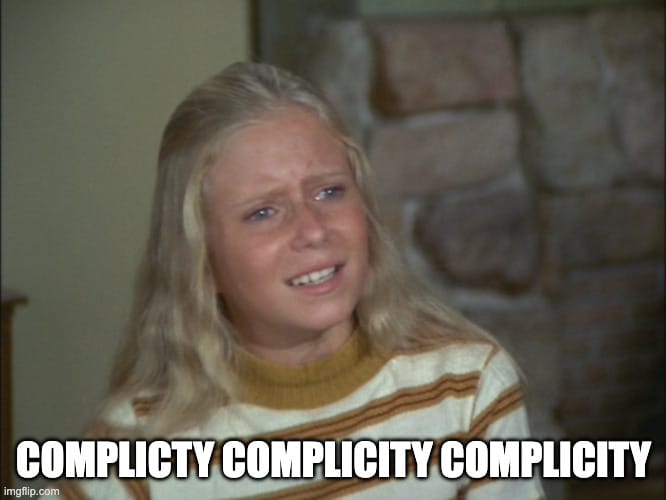
If complicity means "connected to systems that produce harm," then everyone is complicit in everything. The word loses all ethical content. It becomes just: "you participate in society, therefore you're bad." The Jan Brady "Marcia, Marcia, Marcia" meme, but with jagged, fetid teeth.
That's not ethics. That's just the leverage mechanism working. These aren't accidents of discourse. They're features of tribal boundary maintenance. The cattle prod keeps members moving. The crowbar removes heretics. Together they prevent the middle ground where honest participation happens.
III. Ownership (The Pivot)
What if complicity meant something else? What if it meant: acknowledgement of connection. Ownership of your position inside systems whose outcomes you can't fully control.
Not guilt. Not shame. Honest recognition of where you stand.
I teach gun safety. That makes me part of gun culture. Gun culture produces both competent carriers and domestic murders. Teaching safety reduces accidents—maybe 5% of gun deaths. It can't touch the other 95%. Anna wasn't killed by accident. I own this relationship: I do useful work that can't prevent what matters most.
I carry a firearm for self-defense. I participate in the legal framework established by Heller, the same framework that's enabled 20-30 million AR-15s in civilian hands and sanctified the deaths as the "price of liberty." I own this tension: a legitimate individual act inside a horrifying systemic context.
I opposed Oregon's Measure 114. My opposition aligned me with gun rights organizations I don't fully support. It may have prevented disparate enforcement, but it didn't prevent gun deaths. I own this choice: a civil rights argument that doesn't resolve the tribute system.
I pay taxes. I can't stop the war by going to prison. I advocate against it. I articulate my position where possible. I refuse to endorse it. I own this reality: connection to atrocity I cannot prevent through individual withdrawal.
This version of complicity doesn't require guilt. Guilt says: you did something wrong and should stop. Acknowledgement says: you're connected to something complex and should see it clearly. And connection doesn’t equal culpability, but it does create opportunities for taking ownership. Ownership is not endorsement, guilt, or fatalism. It offers a clarity of sorts, anchored to the time and place of your here and now.
The difference matters. Weaponized complicity paralyzes. Honest complicity orients. It clarifies your position. It enables deliberate choices within constraints.
IV. For the Differently Broken
This framework isn't the "right" way to think about complicity. It is simply a way.
It is a way for the weird buggers like me—people who can't maintain tribal membership, who find binary positions suffocating, who need to hold contradictions without resolving them to feel honest.
Some people are built to cleave to one thing. Gun rights absolutists who genuinely believe "shall not be infringed" means what it says. Gun control advocates who've dedicated their lives to regulation. Both groups include people acting with integrity. Bless 'em for that. Their certainty enables sustained collective action. Their tribal structures create political power.
I can't do that. And I've stopped pretending I should.
Not because I'm "more nuanced" or "seeing a deeper truth." But because my brain won't let me maintain the simplifications required for tribal membership. I see the enforcement disparities and I know murder victims. The contradictions are load-bearing for me. Removing them would require lying to myself. And I've discovered I'd rather be honest and politically homeless than simplified and belonging.
This makes me weird, not better. Most people are better served by tribal membership. They get a clear moral framework and community support. I get intellectual coherence for my particular brain, freedom from performance, and the ability to act across domains.
We're not better. We're just differently broken.
If you can maintain tribal membership with integrity—if the simplifications don't feel like lies—stay there. You'll accomplish more through collective action than I ever will through individual navigation.
But if you've read this far and recognized yourself—if the contradictions feel familiar, if tribal membership has never quite fit—you're not alone. There are others in the vacant lot. We don't have a banner or a movement. Just people trying to act with integrity inside systems we can see too clearly.
V. The Garden in the Fire
Tribes are foundational structures, but they become tumorous when they exist only for self-replication. Weaponized complicity is how healthy tribes metastasize. It prevents acknowledging connection without guilt. The other side becomes "complicit in harm," and conversation becomes impossible.
Hope, for people like me, can't be achievement-based.
I spent six years developing my position on firearms. Jury duty accelerated it in three days. Six years of slow orbit, three days of gravitational sling. The framework was already there; the pressure just made it visible.
Meanwhile, the species metastasizes. Tribes harden. Media amplifies. The forest burns while I tend a small garden.
I can't stop the metastasis. Wrong timescale, wrong scale, wrong leverage.
What I can do: Have this conversation. Teach gun safety. Make deliberate choices about which systems I participate in. Write frameworks for other people who can't do tribes. Provision at Costco while marking the stress honestly. Act, not achieve.
Hope isn't "things will get better." Hope is: I can do this specific thing, right now, regardless of outcome.
The action is real. The outcome is uncertain. The hope is in the action itself—not as a mirage that keeps receding, but as something I can actually do. Not perform for an audience. Not optimize for metrics. Just: act with integrity inside constraints, then act again tomorrow.
That's sustainable. That's real. That's enough.
The garden grows during the fire. Both are real.
I'm not offering a solution. I'm articulating orientation. This framework lets weirdos like me live lives we can inhabit honestly.
The rice goes in the trunk. The taxes get paid. The guns get carried. The cloud systems get built. The stress gets marked. The contradictions don't resolve.
You were there. You're still there.
That changes everything. And nothing.