A Playable Folktale: The Gallian Autumn
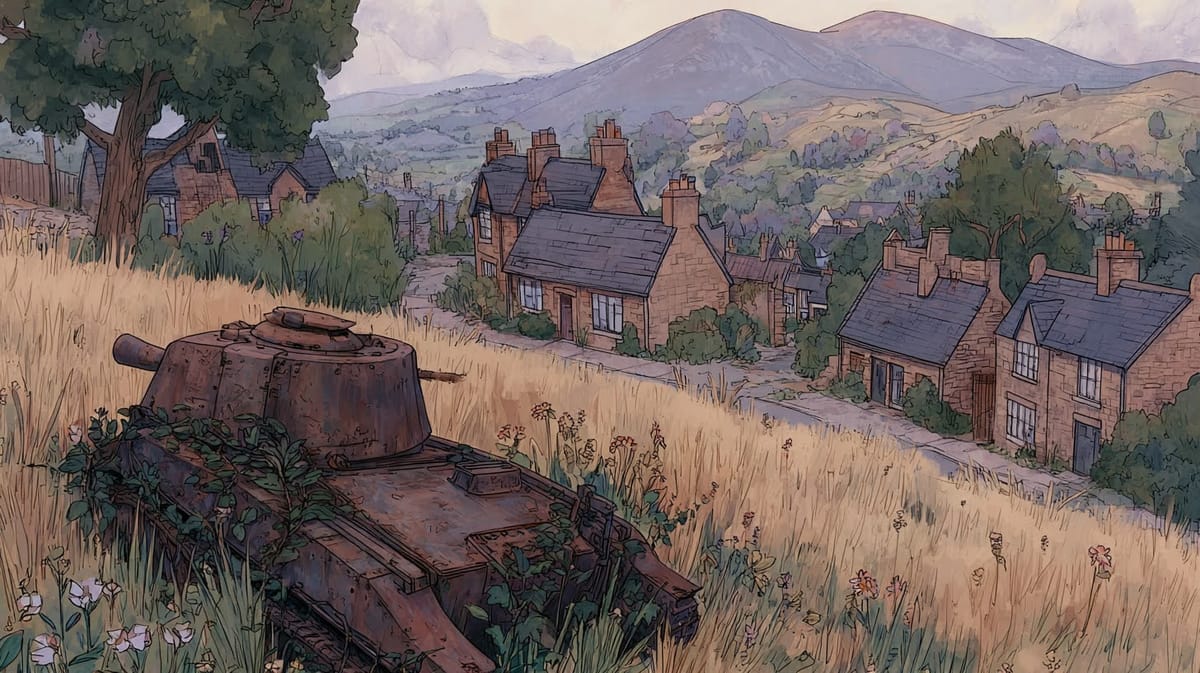
After the armistice, the harvest still comes. So does the cold.
Tone: Melancholic hospitality. Harvest light fading into frost. Beauty that knows it's temporary. Length: 2–4 hours (single session or 2–3 session arc)
THE WORLD
Gallia is an alternate Europe—composite of French villages, Alpine valleys, Germanic market towns. The Great Conflict (1935–1945) ground empires against each other in contested borderlands. The war ended not with triumph but exhaustion. Treaties signed in distant capitals. Survivors left to count the cost.
Your village sits in the Threshold—where one army's advance stalled and the counteroffensive began. The landscape remembers: vineyards replanted over trenches, farmhouses patched with tank armor, roads curving around craters now filled with wildflowers, churches with new bells (the old ones melted for munitions).
It's autumn now—two harvests after ceasefire. Demobilized soldiers relearn civilian life. Refugees drift through seeking somewhere to winter. Each autumn arrives earlier, lasts longer, cuts deeper. The old people mutter about the Lady of the Cold—a figure from winter folktales now appearing at the edges of fields, her gaze turning everything to crystal.
THE SITUATION
This autumn feels different. First frost in late August. Thin harvest with no pattern. Migratory birds passed over without landing. The river runs colder than it should.
People have started seeing her: The Lady of the Cold.
She appears at dusk—standing at forest margins, reflected in still water, glimpsed through morning frost on windows. Those who meet her gaze say the world becomes perfectly clear for a moment, every detail sharp, every color true—and then something inside goes quiet. Not dead. Just still.
The Lady is neither enemy nor friend. She is the season made conscious, the year's reckoning. She comes when warmth has exhausted itself and the land needs to remember how to rest. Her blessing is peace, but it's the peace of forgetting.
The Tensions:
- Memory vs. Forgetting — What must be remembered? What should be allowed to sleep?
- Hospitality vs. Resources — Refugees arrive weekly. The village has just enough for itself.
- Individual Grief vs. Community Need — Everyone carries private losses. How much space can mourning have?
The Question: The Lady is coming—not as invader, but as season. You can't fight winter. What will you preserve? What will you let go?
CHARACTERS
MARCEL KOENIG — Former Artillery Lieutenant, Now Baker, Early 40s
Commanded a battery that held the ridge for eight months. Lost his left hand. Returned to the family bakery. Bakes at night because he can't sleep.
Bonds: Was engaged to Céleste before the war • Taught Theo artillery math • Buys flour from Sofie Wound: Still feels his missing hand. It clenches in phantom memory of pulling the firing lanyard. Hears shells in dreams—not the explosion, but the silence before. Question: The Lady could take the phantom pain. Would you still be yourself?
CÉLESTE MARCHAND — Village Nurse and Midwife, Late 30s
Ran the field hospital in the church basement during the siege. Saw things no training prepared her for. Never married Marcel—it felt like tempting fate.
Bonds: Marcel's former fiancée (tender, unresolved) • Delivered Theo's daughter • Exchanges journals with Hanna Wound: Triage haunts her. She decided who to save when supplies ran short. Keeps a private list of the ones who didn't make it. Question: The Lady could erase that guilt. But should mercy be forgotten?
THEO BRENNER — Railway Engineer, Early 30s, Father
Kept the rail line operational throughout the war. His cooperation with both sides made him suspect to everyone. Wife died in childbirth last year. Daughter Greta is eleven months old.
Bonds: Marcel saved his life during shelling • Céleste delivered Greta • Hanna helps care for Greta Wound: Collaboration guilt. Repaired tracks for whoever held the village that month. Pragmatic, necessary—but his rails brought ammunition that killed neighbors. Question: The Lady offers absolution through forgetting. Is that different from denial?
SOFIE ADLER — Miller and Grain Merchant, Mid-50s
The mill has been in her family six generations. Kept it running by paying "taxes" to both sides. Her pragmatism fed the village. Her compromises make neighbors avoid her eyes.
Bonds: Supplies Marcel with flour • Competes with Hanna for contracts • Employs refugees Wound: Her son served in the Imperial army. He didn't return. She doesn't know which side killed him, or if he's alive somewhere, unable to come home. Question: The Lady could preserve that hope forever—never confirmed or denied. Is perpetual uncertainty better than truth?
HANNA VOGEL — Schoolteacher and Archivist, Late 20s
Too young to remember the last war, old enough to document this one. Collected oral histories during the conflict. Teaches children who don't remember peace.
Bonds: Helps Theo care for Greta (complicated feelings) • Exchanges ideas with Céleste • Archives Sofie's records Wound: Her father was executed as a suspected informer. She doesn't know if it was true. Question: The Lady could freeze that question unanswered. But doesn't the next generation deserve to know?
SESSION STRUCTURE
A ritual of recognition in four movements, each arriving like weather.
Movement One: HARVEST (The Market)
Mood: Provisional normalcy with an undertone of unease
Late afternoon, golden light, harvest market day. Marcel's bread sells out early. Céleste tends a scraped knee. Theo haggles over lumber. Sofie's workers unload flour. Hanna collects stories.
Someone mentions: "Did you see the frost on the vine leaves this morning? In August?"
Let relationships emerge through gestures. End when someone reports something at the forest edge.
Key Beats: One moment per character revealing a bond. The harvest feels adequate but precarious. Someone mentions the Lady. A refugee family arrives.
Movement Two: THE FIRST COLD
Mood: Beauty becoming brittle
The cold manifests in ways that blur natural and unnatural. Visit locations in any order—follow curiosity.
THE MILL — Frost forms on grinding wheat. Ledgers show grain weights matching records from before the war. A woman reflected in the millrace at dawn. Water's song has ice-crystal harmonics. The land remembers its older bargains.
THE FOREST MARGIN — Trees produce spring and autumn growth simultaneously. Animals stand motionless for hours. Shell casings from the war covered in frost flowers. The forest appears as it did in pre-war maps—trenches vanished. Time folds back, seeking an earlier pattern.
THE RAILWAY STATION — Trains arrive on schedule no one remembers sending. Passengers disembark speaking languages from decades past. Ice forms on rails in patterns almost like writing. A manifest lists people who haven't been born yet. The cold pulls at every thread of continuity.
THE CHURCH — New bells ring at odd hours, no one pulling ropes. Frost on memorial plaques, but only certain names. The basement smells of disinfectant and roses. Candles burning for people still alive. The cold preserves everything—grief, guilt, and grace equally.
THE REFUGEE CAMP — Families from the north report the Lady has already taken their villages. They describe it not as destruction but stasis—everything perfect, nothing changing. Children no longer play; they watch the horizon. The cold offers peace, but the price is continuation itself.
Pacing: Slow accumulation like frost. No combat. No enemy. Only the approach of a season that thinks.
Movement Three: THE LADY'S APPROACH
Mood: Understanding arriving like cold through a cracked window
The Lady of the Cold is winter's consciousness—the season aware of itself, the year's reckoning made visible. She appears when a place has burned too hot for too long. War generates heat. The land becomes feverish. She comes not to punish but to restore balance—stillness, forgetting, the peace of things held in crystal.
Her gift is double-edged:
- Preservation without change — Everything perfect, nothing grows
- Peace through forgetting — Grief ends, but so does joy
- Rest resembling death — Not dying, but no longer becoming
Those who accept fully become crystallized—communities in perpetual autumn, beautiful, peaceful, eternal, empty. Those who reject entirely burn themselves out—clinging to warmth until they exhaust their resources before spring.
Personal Stakes:
- Marcel: She could take the phantom pain. But would he still be himself?
- Céleste: She could erase the triage guilt. But should mercy be forgotten?
- Theo: She offers absolution through amnesia. Is that different from denial?
- Sofie: She could preserve hope forever. Is uncertainty better than truth?
- Hanna: She could freeze the question of her father. But the next generation deserves to know.
Movement Four: THE WINTER COMPACT
Mood: Quiet reckoning
The Lady stands in the village square. Snow falls without accumulating. Not threatening, not comforting—simply present, like weather.
ACCEPT THE COLD — Welcome the Lady fully. Let the village crystallize. The harvest never rots. The dead are never truly gone because grief doesn't progress. Time stops measuring change. Amber. A photograph. A held breath. Years later, travelers report a village where it's always market day, the bread always fresh, and people smile but never laugh.
REFUSE THE COLD — Reject her offer. Keep every fire burning. Remember everything. Fight winter with all resources. By spring, granaries empty, half the refugees dead, survivors exhausted. Fever. Defiance. Pride at terrible cost. They teach their children memory matters more than comfort. The Lady watches from the horizon, patient. She'll return.
THE COMPACT — Negotiate with the season. Choose what to preserve and what to release. The group identifies what must be remembered—names, lessons, grief that teaches. And what must be released—guilt that paralyzes, grudges that poison, trauma that prevents healing. Make offerings to the cold. In return, natural winter—hard, but survivable. Negotiation. Maturity. Spring will return, but find them changed. Some things preserved in ice, beautiful shrines to what was lost. But life continues around them. The children know the stories and how to plant seeds.
How to Decide: Not a vote—a conversation. Each character states what they need. Find consensus or honorable disagreement. If they can't agree, the Compact becomes personal rather than communal.
Final Image: Snow falling on warm bread. A child asking what the Lady looks like. Someone planting spring bulbs in frozen ground. A letter arriving, and someone choosing whether to open it.
NARRATOR GUIDANCE
You are conducting a seasonal ritual—guiding players through the recognition that some losses are necessary for life to continue.
Responsibilities: Embody the season. Hold the question: "how do we live with this?" Protect the tone—melancholic but not despairing. Trust emergence. Be the Lady's voice when she speaks.
When the Lady Speaks (rarely):
- "You've been warm so long. Don't you want to rest?"
- "I take nothing that isn't already ending."
- "Spring only returns when winter has done its work."
She isn't trying to convince. She states conditions.
Manage tone: Too dark → Small joys: bread rising, children laughing, a refugee family finding shelter. Too light → The cold: frost spreading, names forgotten, the Lady's patient presence. Stalled → "What are you most afraid of losing?" or "What would you most like to forget?"
Player Agency: They can't defeat the Lady—she's a season. But they can choose what to preserve and release, decide how the village meets winter, shape what spring finds.
THE LADY OF THE COLD
Appearance: Tall, indeterminate age. White that might be fabric or frost or birch bark. Hair like snow on branches. Eyes clear as January sky. Beautiful the way winter mornings are—perfect, sharp, a little cruel.
Voice: Quiet. Measured. Like wind through ice. She doesn't persuade—she states conditions.
Movement: Appears at margins. Moves like weather. You don't see her approach—just realize she's present. Frost remains where she stood.
Sample Dialogue:
- "You've carried this so long. Doesn't it hurt?"
- "I'm not cruel. I'm the rest that comes after labor."
- "Some things should be forgotten. That's not evil—it's mercy."
- "You can keep fighting warmth into winter. But what will spring find?"
SAFETY
Content: War trauma (oblique), grief and loss, economic precarity, questions about giving up (through the cold metaphor), collaboration guilt.
Use your table's safety tools. The tone already leans toward gentleness.
After: Take a breath together. Drink water. Check in.
VARIATIONS
One-Shot: Move through all movements, focus on 2–3 locations. Arc: Session 1: Harvest + first cold. Session 2: Locations + Lady appears. Session 3: Recognition + Compact.
Other Regions: Coastal Gallia (sea remembers drowned ships). Mountain Gallia (avalanche and memory entangled). City Gallia (ghosts walk rebuilt boulevards). Southern Gallia (drought, dust, the desert's patience).
The Lady waits at the forest edge. The harvest is gathered. The choice approaches.