A Milk Run: A TiGGR Scenario
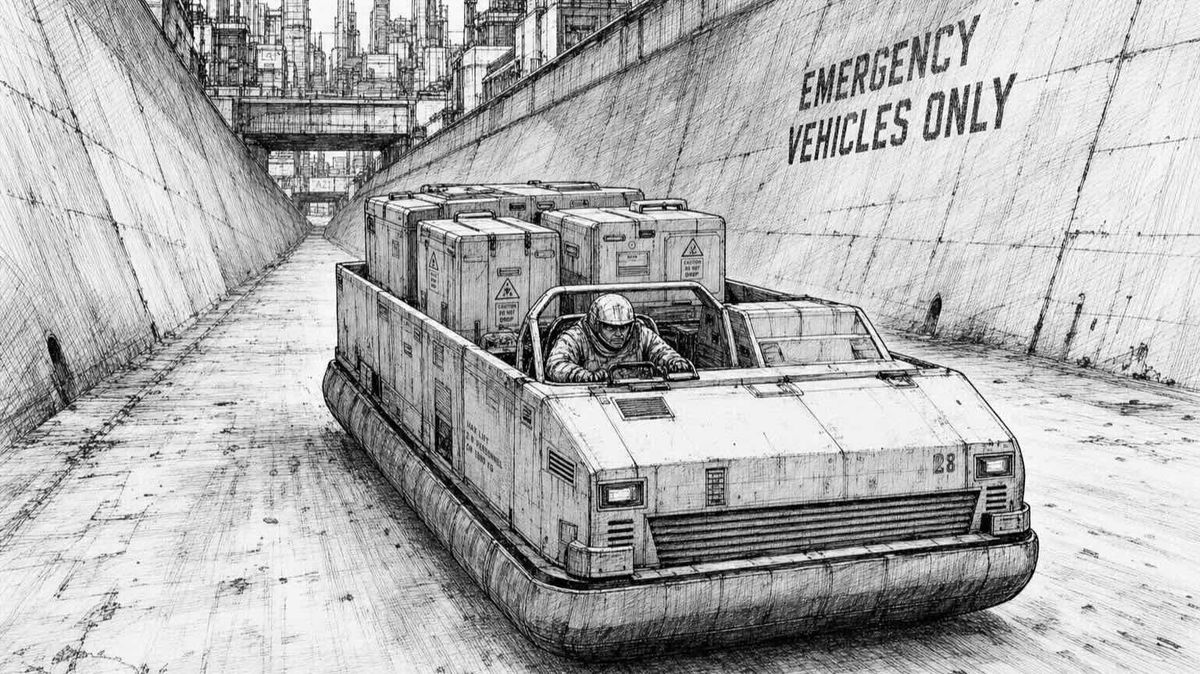
Touchstone: Jacques Tati's timing comedy + Lupin III's competent-crew improvisation — dignified people versus an uncooperative system, with a deadline.
Components: 2d6, pencil and paper, the TiGGR core rules, an LLM optional but encouraged.
Players: 1 GM + 2–4 crew.
Playtime: One long session or two short ones (this is a meatier scenario than TiGGR's default three-scener — five scenes, ~2–3 hours).
Tone: Gentle slapstick under real time pressure. Nobody throws a punch. The villain is a closing window.
THE PITCH
A world of billions is starting to go hungry inside a working economy, and the only thing standing between it and a worse month is a dozen nondescript gray boxes that have to get from a warehouse to a ship to another ship before a clock runs out. The crew gets the job for the least heroic reason imaginable: their ship is the only one that can be in hyperspace before the end of the day.
It is sold to them as a milk run. It is a relay race against ordinary friction, and then a quiet question about why the spare parts were bad in the first place.
There are no pirates in this scenario. There is no boarding action, no ancient secret, no shootout. The crew will talk, sneak, fast-talk, fix, fly, and improvise their way through a living logistics system that is not their enemy — it's just busy, and indifferent, and running on a schedule that doesn't care about them. The drama is whether the boxes arrive in time, and what it costs the people on the other end if they don't.
THE ONE RULE
TiGGR's core rule, stated plainly: fail forward, gently. A failed roll never stops the story — it bends the shape of success and usually makes things funnier and tighter. Failed the dash for the shuttle? You make it with the doors closing on someone's coat which flaps in the slipstream for the entire flight. Failed the canal run? You clip a footbridge, bend a strut, and limp the last stretch while the engine whines an indignant wail. Failed the smooth-talk? The official agrees — then changes a term, or remembers your name wrong later. Failure costs time, dignity, or both. It never costs the mission outright, and it never costs a life.
Two consequences of this, specific to this scenario:
HP is literal, and it almost never comes up. 0 HP means knocked out, exhausted, overwhelmed — reset next scene, per TiGGR. But nobody is fighting here, so HP sits dormant. It only wakes if someone goes into the canal, or if you run one of the optional darker complications where a person turns hostile. Treat HP as the safety net it is: present, rarely touched, foam-padded.
The clock is the real health bar. Everything that would be "damage" in another game is, here, time. The thing that drains is the Margin (see THE MARGIN, below). A lost argument with a tired bureaucrat doesn't hurt anyone — it costs you twenty minutes you didn't have, and the relief cruiser at your destination is degrading the whole time. Bodies are safe. The schedule is not.
So you can run the entire thing as broad, warm, physical comedy — the revolving-door, wrong-elevator, almost-missed-the-connection register — while the stakes stay genuinely tense, because the planet's hunger never foam-pads. Think of Jacques Tati's pratfalls, with a train to catch.
THE WORLDS
You don't need a star map or a sector survey to tell this story. Here's what's true.
Sevren is the world in trouble — a planet of billions that feeds itself through engineered, high-intensity agriculture: bioreactors, culture vats, food synthesis, not open farmland. That's why it can support billions, and why it has no rustic fallback. It's also balkanized — several sovereign polities sharing one planet, each with its own ports, its own rationing, its own public to answer to. Relief is therefore always political: every crate lands inside somebody's borders.
The Greywilt is the disaster. About fourteen months ago a contamination cascade moved through Sevren's engineered staple cultures and collapsed the bioreactor banks in two food-synthesis arcologies. Not an explosion — a slow, systemic failure nobody caught until the margins were already gone. The lights still work. The trains still run. People still go to work. That's exactly why the logistics are hard: a dead world needs nothing; a living one in trouble needs precisely the right thing, at the right moment, through systems that are all under strain.
The relief flotilla is four garden cruisers — converted bulk hulls turned into mobile agricultural districts (hydroponics, algae vats, protein bioreactors, culture vaults) — operated by Calder-Voss Agronomics under a relief contract. Their job is to keep Sevren fed and supply the clean culture stock it can't currently make, while local production restarts. The flagship is the Verdant Promise.
Calder is the launch world — the industrial neighbor where the crew starts, three light-years from Sevren. It fabricates the hardware. It has a smoggy atmosphere that’s more a nuisance than poisonous (filter masks are cheap, ubiquitous local kit; assume the crew wears them outdoors — only a complication if someone forgets). It also has its food issues, characterized by rationing via districts, the occasional unrest, and universal black markets. Carry this into Scene One: the launch world is not a safe harbor calmly shipping aid to a stricken neighbor — it's straining its own belt to do it. The ration checkpoints, the relief-coalition queues, the wardens watching for looters, the supervisors stuck in allocation meetings — all of that is Calder's own crisis, a few notches behind Sevren's, and the crew threads it on the way out. The starting line is not comfortable. It's just less broken than the finish.
Three failures, not one
Keep these distinct — it's the spine of the whole thing, and blurring them quietly wrecks it:
- The Greywilt — the biological disaster that crippled Sevren's food base. The disease.
- The controller failure — the Verdant Promise's bioreactor controllers have died, crippling its ability to grow the clean cultures Sevren depends on. The symptom the crew is sent to treat.
- The batch defect — the industrial flaw that explains why the cruiser's installed units and its onboard spares both failed, and why this is urgent. The thread that can grow into a campaign.
The modules did not cause the Greywilt. A world already in slow trouble has a different weak link snap at exactly the wrong time. That's the hinge.
The cargo
A dozen nondescript, sealed gray boxes — Mycel-class bioreactor controllers, each about the size of a small guitar amplifier, with handles, warning labels, certification chits, and paperwork. Trivial to carry; fussy to be responsible for. The drama is never their weight — it's custody (who's allowed to release and sign for them), certification (are they genuine), and condition (did the cold chain hold).
Why nobody on Sevren can just make more: Calder fabricates the chassis, but the modules need certified firmware and a controlled biological calibration culture that can't be re-certified inside the relief window. It's not a backward planet — it's two modern worlds hitting the edge of one specific, certified, and incompatible supply chain.
The one clue (the F-2 module)
The replacements are from a revised production run — and a crew that inspects the cargo (best done in transit; see Scene 4) finds everything almost right, with one oddity: the manifest lists every unit as firmware revision F, and all of them are — except one, which reads F-2. Not damage, not obviously wrong; just a unit that doesn't match its paperwork. It points at "the revised run isn't as uniform as claimed" without confirming anything. That's the whole clue. Don't explain it. (Optional swaps: a six-minute gap in one thermal log, or one seal with a serial from a different lot. Keep it to one.)
THE CAST
NPCs in A Milk Run are not villains or allies — they're other people doing their jobs under bad constraints, exactly as TiGGR's "what would happen in a cartoon, but kind" instinct suggests. None of them need stat blocks; none of them get fought. Each one is a situation with a want, a way they push, and the roll it takes to move them. (If you escalate into the optional darker complications and someone does turn hostile, give them 1–3 HP per TiGGR and run it — but that's turned off by default.)
Renko Aalsund — relief-logistics coordinator. Found the failure, traced the parts, spent eleven hours discovering every proper ship is unavailable. Blunt, exhausted, values time over ceremony. Hands over the codes and the priority chit and is already turning to the next problem. Not lying — just out of time to explain. He appears in person only in Scene 1 (the pitch); once the crew jumps, the no-FTL-comms rule (Scene 4) strands him, so his only later word is the message they carry with them.
Idun Petrel — operations manager, Calder-Voss Agronomics. Calm, well-dressed, answers the question you asked and not the one you should have. Protecting lives and liability and a workforce, all at once, and not pretending otherwise. Will make the bonus contingent on discretion. Not a villain. (Appears for one beat in Scene 1, and is the face behind the inquiry hook in Now What? — she's the hand on that door, early and late.)
Onnu Vance — supervisor at the Tanby depot, where the cargo waits in a release cage. Stuck in a closed meeting deciding which of Calder's own districts get their rations cut this week — a thing genuinely more important than the crew's errand. Difficult, decent, three problems deep. How you approach Vance decides everything (Scene 2).
Bree Osei — a young Calder relief-zone warden on a cordon, having the worst shift of a short career. Told to watch for looters moving valuables out of one of Calder's own rationed districts — and here comes a sled full of sealed gray boxes crewed by strangers in a hurry. Frightened, not hostile. The hinge of the scenario's ethics (Scene 2).
Capt. Lessa Corin — commands the Verdant Promise and holds emergency authority over flotilla resource allocation. Pragmatic, protective of all four ships, not just hers. Has already, on her own authority, promised two modules to the failing sister ship Tideturn — which puts her at odds with Aalsund's plan. Not a jurisdictional error; plan-versus-presence (Scene 5).
Doreh Sael — the Verdant Promise's senior bioreactor specialist. Inspects, accepts, and installs the modules. Won't fit a unit she doesn't trust. Her reaction to the F-2 module is the verification payoff.
Dock Boss Ferren (optional) — a Calder port fixer and old contact. Helps for a favor owed, payable in cargo or silence. Useful if a player wants a contact to call.
THE MARGIN
This is the heart of the game. The one number to track.
The Verdant Promise has a cushion of time before its degradation crosses a hard line. Call it the Margin. It starts at 6 and the GM tracks it on a scrap of paper all session. Delays subtract from it; clever, kind, or daring play adds to it; one stretch of the journey can't be touched at all.
The journey (fiction):
- The ground relay — catch the shuttle, grab the cargo at Tanby, get back, make the launch slot. (Scenes 1–3.)
- Leg 1: Calder surface → the IDP (Interstellar Departure Point): ~12 hours.
- Leg 2: Hyperspace crossing: ~48 hours — fixed and un-gameable. Nothing shaves it. This is the immovable middle. (Scene 4.)
- Leg 3: IDP → Sevren orbit: ~12 hours — gameable (the slingshot lives here).
- Minimum nominal run: ~72 hours of transit. A clean ground relay arrives with the cushion intact.
Moving the Margin:
Reading the result at delivery (the Margin when the crew docks):
- 4 or more → Comfortable. Tense but holding. The cruiser returns to full output; the next lighter goes down full; a district's projection ticks from "ration reduction scheduled" to hold. The clean win.
- 0 to 3 → Clawed back. On time, barely, no slack. Rations were nearly cut. Sael is grateful and exhausted. (With more ways to lose time than to gain it, a hard-fought run lands here — which is the intended feel.)
- Below 0 → Late. Rations were cut before you landed. Not catastrophe — a worse Sevren: tightened rations, protests at distribution centers, a missed production window. The crew can see exactly what the lost hours bought.
The elegant part: the Margin you carry into Scene 5 decides whether the climax is a victory lap or a Hail Mary. Sevren's approach is congested (see Scene 5), so a standard arrival costs −2 — which means the slingshot is a real decision for almost everyone, not a shrug you can wave off. A flush crew can pay the toll and still win; a crew that scraped through Acts One and Two must gamble to claw back a clean delivery — Climactic 10, everything riding on it. Scene One determines the stakes of Scene Three. That's the whole design.
THE CREW
Standard TiGGR characters (see the one-pager): 3 points across Body / Mind / Charm, a Role, a Special Ability (+1, situational, once per scene), Signature Gear (+3, once per scenario), HP 5.
This is a crew of working spacers for whom this ship is the best available option. Roles that fit: the Pilot (flies the sled, attempts the slingshot), the Fixer (paperwork, contacts, reading the catch), the Operator (clients, contracts, knows when they're being lied to), the Mechanic (the ship is their instrument). Suggested Special Abilities:
- "I Know a Guy" — +1 Charm calling in a favor (e.g., Ferren).
- "Read the Room" — +1 Mind assessing whether a client or gig is what it claims.
- "Hold Together" — +1 Body when a vehicle or system is failing at the worst moment.
- "Hands Like That" — +1 Mind on a precise technical maneuver (firmware, a slingshot plot).
The chit (a crew asset, not a personal item). Aalsund hands the crew a transit-priority chit: once during the run, it grants +3 to one launch- or transit-authority roll, or auto-recovers a missed launch slot. But it's a spent favor — once used, Aalsund can't spend that same goodwill later to shield the crew if the F-2 question becomes an inquiry. Go fast now, maybe get entangled later. Let them choose with eyes open.
The ship — the Nonesuch. Not a stat block; a place and a character. A tramp freighter with a mortgage. Give it, together, in one minute: a name's worth of history (how'd you get it — salvage, inheritance, a card game?), one Problem that's always wrong (the cargo door sticks; the galley smells of ozone; the nav voice randomly speaks a language nobody aboard knows), and a sound for when things are fine and a different one for when they're not. The Problem never gets fixed. It gets managed. It's the ship's personality.
To be continued...