A Milk Run: Part Three
Scene 4 — Hyperspace (the immovable middle)
Forty-eight hours sealed in the dark. Nothing you do shaves it. No rolls touch the Margin here — protect it. This is the breath between the relay and the arrival, and it's where the doubt grows.
The comms rule (your own physics, no borrowed system): nothing outruns a hull through hyperspace — there is no faster-than-ship signaling. Nobody at Sevren knows you're coming. Everything Aalsund told you traveled with you, and is already hours stale by the time you read it.
- The carried message (read it now): Aalsund's pre-launch note — the Verdant Promise has started pulling parts from the Tideturn to stay ahead, so the margin's thinner than promised; and the Tideturn is now reporting an anomaly in the same subsystem. Probably unrelated. Hand the cargo to Corin's people and no one else. — And here's the quiet horror: "now reporting" is already a day old, and by the time you arrive it may have become something else. There is no current information about the place you're flying toward. There can't be.
- The F-2 thread (if they inspected — Mind, Risky 6 / Dramatic 8): the odd module is genuine, certified, just a later sub-revision than the rest. A careful crew can reach the inference — "this looks like a batch defect that may be wider than one ship" — but cannot reach the cause (accident? sabotage?) from inside a sealed ship. Let the inference be solid and the conclusion be unavailable. That gap is the mood.
- The fork (GM, no rolls): Standalone (recommended) — the defect is real but contained, the F-2 is the fixed unit, the anomaly resolves; the week's dread was just dread. Larger plot — the defect is spreading and the crew holds the first evidence. Sabotage — someone made the originals fail. Let the crew's own behavior tilt it: pried and recorded → lean toward plot; kept their heads down → let the milk run be a milk run.
End on the grey peeling back: stars, a sun, a blue-green world thick with traffic — and, on the approach, a gas giant.
Scene 5 — The Slingshot & the Green Light
Check the Margin. It sets the stakes of everything that follows.
- Margin 6+ → flush. Even after the approach toll (below), a standard arrival still lands Comfortable. The slingshot is flair: nail it and you come in gloriously early; miss it and you only downgrade to a sweaty Clawed-back — you can't fall to Late from here.
- Margin 2–5 → the live choice. A standard arrival pays the toll and banks a Clawed-back win — real, but no longer Comfortable. The slingshot gambles that safe win for a Comfortable one, with Late on the downside. This is the decision the toll exists to create.
- Margin below 2 → behind. The toll sinks a standard arrival to Late. The slingshot is your only road to a win — Hail Mary, Climactic 10.
The approach is a traffic jam — and the relief effort built it. Sevren's near-orbit is congested with the very operation the crew came to help: four garden cruisers holding station, a ceaseless stream of loaded lighters and returning empties, and clearance to be begged from a balkanized planet's worth of port authorities who don't coordinate with each other. Space is enormous; an orbital approach under relief siege is a delicate, oversubscribed orchestra. So a standard arrival costs −2 Margin — the queue is the toll. The slingshot's whole appeal is vaulting it: swing in off-axis around the gas giant, skip the orchestra, and either shave the leg or overshoot trying.

★★ THE SLINGSHOT (the climactic gamble). A gravity boost around the gas giant can shave the final approach leg in half.
- Mind, Climactic 10 — and it stacks. A high Mind (up to 3), a fitting Special Ability (Hands Like That, +1), and the right Signature Gear (+3 — the pink fuzzy dice over the cockpit, the foot-shaped Go! pedal welded to the drive, why not) can all pile onto the one roll, shaving a hard 10 down to a near-formality where only snake eyes plays the sad trombone. Whether the crew finds that line is their problem, not the GM's — and the bigger the stack, the louder the 2 lands when it finally comes up.
- Success → +6 Margin. You whip around and come in early and clean — off-axis, skipping the congested approach entirely.
- Failure → −6 Margin. You misjudge the burn, sling past Sevren, and have to loop back. Nobody's hurt, nothing's destroyed — the Verdant Promise radios a dry "Nonesuch, confirm you meant to do that." This is the overshoot pratfall: peak fail-forward.
- Decline the gamble: fly the standard approach and pay the −2 queue toll. (A flush crew at 6+ still lands Comfortable; a crew at 2–5 banks a Clawed-back win; a crew below 2 arrives Late.)
★ TALK THE APPROACH (the negotiator's option). A clever crew will notice this is a clearance problem, not a piloting one, and ask to talk their way to a priority slot instead of slingshotting. Let them — it's the most on-theme instinct in the scenario (the whole game is about talking through indifferent systems, not muscling them).
- Charm or Mind, Dramatic 8 (you're working a harried traffic controller, or calling in a name): success → cancel the −2 toll (a priority slot; you arrive on schedule, no slingshot needed). Beat by 4+ → they wave you to the front, +1 on top. Ordinary miss → you wait the normal queue and eat the −2 anyway (fail-forward: no harm, just the toll you tried to dodge).
- It's a toll-canceller, not a slingshot-beater. It reliably erases the −2 but caps at +1 — the low-variance counterpart to the slingshot's high-variance ±6. The pilot gambles for a stylish early arrival; the negotiator quietly makes the traffic jam not their problem. Both valid; different stats, different risk shapes — and it pulls the talker into a finale the slingshot-only version left to the pilot.
- Whom do they call? Corin can grant a priority slot — she wants those modules — but now the crew owes the flotilla a favor (a Now What? entanglement). Or spend the priority chit if it's unspent — but that's the same chit that buys launch-queue speed and shields the inquiry, so burning it here burns it there.
- The flagged crew's bill comes due. If the Nonesuch launched with a flag in its transponder (Scene 3), that annotation arrived encoded in your squawk — written at Calder departure, carried here at hull speed because nothing outran you — and it's exactly what a balkanized port authority squints at. The clearance roll is Climactic 10 instead of 8 (or: clear it only by spending the chit). The crew that bulldozed Osei or the VIP lane finds the polite shortcut hardest precisely because they bulldozed.
No cavalry. There is no second ship with a better fabricator coming to scoop the crew if they blow it. The Nonesuch is the only thing that can do this — that's the whole premise, and it has to stay true to the last second. A failed slingshot means the crew is late by their own hand, and that costs (below) — it does not get taken out of their hands by a rescue. Foam-pad the bodies and the dignity-floor; never the consequences.
GM SIDEBAR — The Approach Toll & the Vanity Slingshot. Because a standard arrival costs −2, the slingshot is now a real decision for almost everyone — not a shrug. The exception is the flush crew (Margin 6+): they alone still win Comfortable by simply paying the toll, so for them the gamble is pure vanity — flair risked against their own cushion. (They can't even fall to Late: from a flush 6, a miss is −6 → exactly 0 → Clawed Back. They can only downgrade a clean win to a sweaty one — its own special humiliation.) Everyone at 2–5 is making an honest bid, not a vain one: a guaranteed Clawed-back win, or a roll for Comfortable with Late on the downside. Either way, offer it neutrally — state plainly what a standard arrival banks at their Margin, then let the show-off in the group reach for the rope. Don't sell it; a ref who hypes "you could come in early!" can talk a table into a worse result, which isn't the bit. The bit is that they chose it.
Then savor whichever way it breaks:
- Sad trombone. From a flush 6, a miss is −6 → exactly 0 → Clawed Back. A standard arrival would have paid the toll and still landed Comfortable (at 4); they reached past a guaranteed clean win for flair and came down sweaty. Hubris rendered as orbital mechanics — with the people-padding holding even here: nobody's hurt, the boxes still arrive, only the swagger is wrecked. Cue the dockside applause.
- Super-flex. They make it. They come whipping around the gas giant and arrive early and clean on a roll they had no business needing — the bravura move by people who didn't have to make it. This earns the opposite of the overshoot's ironic clap: flight ops a little awed, Sael shaking her head with a grin, the kind of arrival that becomes the story the dockhands tell about the Nonesuch. Same green light — but they put a bow on it.
The ethic still holds, just narrowed by the toll. A flush crew knows when not to be a hero — pay the toll, take the Comfortable win, go home; gambling that is auditioning for a flashier genre. But for everyone else the toll turns the slingshot into an honest call rather than a vanity: a safe Clawed-back win, or a real reach for Comfortable with Late on the downside. Either way the genre answers in exactly two voices — the sweaty save, or the bow on top.
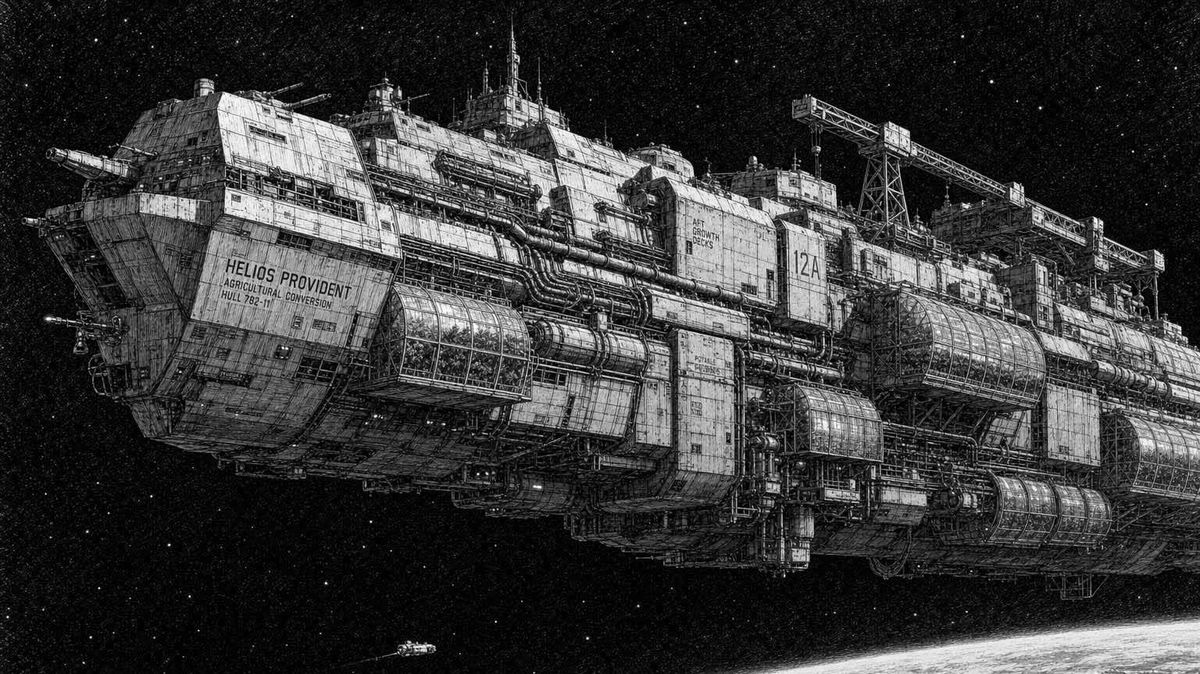
Docking with the Verdant Promise is geography, not a roll — a tramp freighter sliding under a hull the size of a district. The hail is live (comms rule): flight ops answers too fast, all its flatness gone — "…say again your cargo." A pause. "Understood. And — thank you. We weren't sure anyone was coming." They didn't know you existed until this second.
The competing claim (roleplay, no roll). Corin has promised two of the modules to the failing Tideturn — her flotilla authority against Aalsund's manifest. A real triage fork with no villain: concentrate (all modules to the Verdant Promise, maximum total output, the Tideturn sacrificed) versus distribute (two cross over, neither cruiser at full, but four hulls survive). The crew are technically just couriers, but Corin treats them as people whose read she respects. If they agree to run the two modules over themselves → a ready-made second job (sequel hook).
Verification — the F-2 payoff. Sael inspects before she accepts.
- Disclosed the F-2 honestly: on the standalone path she relaxes — "F-2? That's the later sub-revision. The fixed one. I'd rather have one F-2 in the batch than a set that's clean uniform F." The odd unit is the good unit; the whole truth, told without a lecture: there was something to fix, it's being fixed, it's contained.
- Hid it and she catches it: she accepts the cargo — she has no choice — but the warmth goes out of the room. Concealing a non-problem creates a problem.
- Larger-plot flip: she frowns — "F-2 is the recall mark. Where did Calder-Voss get a recall-marked unit and ship it as good stock?" — and the delivery becomes the investigation's first scene.
The green light (the real climax — keep it mundane). Sael carries the first module to a panel that's been dark for days, seats it with two latches and a quarter-turn, and waits while a calibration bar crawls. Twenty minutes. Then a row of amber indicators goes, one by one, to green. A pump spins up behind the bulkhead. "Okay," she says, to no one. "Okay." No music swell. A gray box goes in a slot and a light changes color. The plainness is the meaning.
Then show the result, per the Margin (see THE FINALE OUTCOMES).
THE FINALE OUTCOMES
Read the Margin at delivery and show it — never narrate it as a scolding.
Comfortable (4+): Bioreactor decks back to rated output. The next lighter down carries a full load. A surface district's projection ticks from "ration reduction scheduled" to hold. Sael finds the crew on the dock, presses a standard ration cube into someone's hand: "We grow these again this week, because of you. I know it doesn't look like much. It isn't supposed to. That's the whole point." A small, complete, civilian victory — won by competence, with nobody shot.
Clawed back (0–3): Same green light, dimmer coda. The board says hold where, an hour earlier, it would have said restore. Sael is grateful and tired. The crew can feel exactly how close it was.
Late (below 0): The modules still go in — but the rations were cut before you landed. A worse Sevren: tightened distribution, protests, a missed production window. Not catastrophe; a cost the crew caused and can see. If they got here via a failed slingshot, the humiliation stays local and kind — flight ops have been replaying their approach telemetry; the dockworkers give them a slow ironic round of applause as the ramp comes down. The only people who saw are the ones they let down, being decent about it. (No newscast, no audience — the ache here is insignificance, and a planet's news cycle would invert it.)
To be continued....