A Funny Thing Happened on the Way to Sevren
How trying to port an old space adventure into a tiny game accidentally produced a reusable mechanic — and what it taught us about clocks that have opinions.
We did not set out to invent anything. We set out to deliver a dozen gray boxes. The mechanic was just what we found in the warehouse.
This is a short essay about a detour — the good kind, where you're looking for the highway and end up somewhere better. We'd like to walk you through it in the order it actually happened, because the punchline only lands if you've taken the wrong turns with us. The thing we built makes very little sense as a feature you'd plan. It makes total sense as a thing you'd back into while trying to do something else and refusing to cheat.
I. The Detour
It started with an old adventure called A Milk Run — a relay job in the Classic Traveller mold, with one stubborn rule attached: no pirates. No boarding action, no villain, no shootout. A crew has to carry replacement parts across space to a failing relief cruiser before a clock runs out, and the only antagonist is synchronization failure — busy depots, tired officials, closed roads, a launch slot that won't hold. Competent people versus an indifferent machine. Jacques Tati with a train to catch.
The obvious move was to build it on We Jam Econo, our own little game about gig-economy crews in space. WJE is foam-padded — nobody dies — and it has no villains, just other people having their own bad day. On paper, a perfect home.
It was not a perfect home. It was the most instructive failure in the whole project.
WJE is built on an orbit. Its entire thesis is persistence, not progression: you don't climb and you don't fall, you maintain altitude, you take the next gig, the situation never resolves and never collapses. Which means the one thing WJE is structurally designed to dissolve is an escalating stake. "Does the planet go hungry if you're late?" is precisely the question its mechanics exist to neutralize. Porting A Milk Run into WJE would have quietly deleted the exact thing the adventure was about.
And there it was, the lesson, arriving early and uninvited: stakes and persistence are different axes. We'd been carrying "no combat, foam-padded, kind" around as if it were one property. It's two. WJE has the kindness. It refuses the stakes. We needed both, and we'd just proven our favorite tool could only give us one.
So we backed out of that garage and went looking for a humbler one.
II. The Gap
We fell back to bare TiGGR — our tiny generalized RPG. Two dice, three stats, three difficulties, thirty minutes, zero fuss. And TiGGR is, by deliberate design, a momentum game. Hit points reset every scene. Character growth is vibes, discussed at the table, never tracked. Nothing persists. That's the pitch, and it's a good one: the system is fast precisely because it carries no luggage between scenes.
It is also, just as deliberately, silent about one thing.
A momentum game is wonderful at "can you pull this off, right now?" It is structurally mute on "is the larger thing slipping away while you do?" When every scene is a fresh slate, nothing accumulates — which is liberating, and which also means the system has no native way to say the situation is degrading underneath you. There's no clock. There's no track. There's no number that remembers.
You can see the problem. A Milk Run is entirely about a situation degrading underneath you. A cruiser is failing on a timer while you fight ordinary friction; the whole drama is the gap between how fast you can move and how fast the margin erodes. The single thing TiGGR couldn't express was the single thing the adventure was about. We had picked the one toolbox missing the one tool.
This is the part of the story where a sensible person adds a subsystem.
III. The Constraint That Forced the Answer
Here is where it gets funny, and here is where the no-pirates rule stops being a flavor choice and starts paying rent.
We reached for the normal pressure valves — the ways a game conventionally says this is getting dangerous — and found every single one of them welded shut by our own ethic.
Hit points? Can't carry the tension: there's no combat to spend them, and TiGGR resets them between scenes anyway. A villain? There isn't one — that's the whole premise; the antagonist is a schedule, and a schedule has no hit points to whittle. Consequences on the characters? Foam-padded; bodies are safe; the kindest rule in the document forbids the threat from landing on a person.
We had, with great care, sealed off every conventional exit. The danger could not be a fight, could not be a person, could not fall on a body.
Which left exactly one place for the pressure to go: a number that is neither a character nor a combatant. Not anyone's hit points — the situation's. The cruiser's cushion of time, tracked on a scrap of paper, draining as you stumble and refilling as you're clever, owned by no one at the table and felt by everyone.
We want to be honest about the shape of this, because it's the moral of the whole essay: the no-combat ethic did not cost us a tension system. It produced one. We'd boxed ourselves in so thoroughly that the only way out was to invent the thing we were missing. The constraint wasn't a tax on the design. The constraint was the design, doing our thinking for us.
We called the number the Margin.
IV. The Thing Itself
The Margin is one shared number. It starts at a value the GM picks — generous or tight — and moves both ways all session. Cleverness, grace, and daring add to it; delay, force, and fumbling subtract. One stretch of the journey (the long crossing in the middle) is immovable, untouchable by any roll, because a clock needs at least one fixed wall to push against or the whole thing turns to taffy. At the end you don't read it as win or lose. You read it as how it landed — comfortable, clawed-back, or late, all of them endings, just differently colored.
What took us a while to articulate is the slot it fills, and naming the slot is what makes it reusable. The Margin is a third kind of thing from anything TiGGR already had:
- Hit points are personal, contested, and reset. They answer: are you okay right now?
- Progression is personal, narrative, and slow to accrue. It answers: who are you becoming?
- The Margin is shared, uncontested, and persists within the scenario. It answers: is the mission slipping?
It sits above the HP resets — it remembers across scenes when nothing else does — and below progression — it never crosses the threshold into the next story. HP is the body. Progression is the soul. The Margin is the situation: a table-level resource that nobody owns, everybody feeds, and which tracks the world's patience rather than any one person's pulse.
Two rules keep it TiGGR-shaped rather than turning the tiny game into a heavier one:
It is not a victory condition. It colors the outcome; it doesn't gate it. There's no "you failed" line — there's a worse Tuesday for the people on the other end. This is just TiGGR's own fail-forward principle ("failure bends the shape of success") scaled up from the single roll to the whole scenario. Fail-forward, made cumulative.
It is not carry-forward currency. It evaporates when the story ends. You can't bank it, hoard it, or optimize it across sessions. It converts into what happened and then it's gone. This is the load-bearing restraint: the moment a tension track persists between scenarios, it quietly becomes progression-by-another-name, and drags a momentum game toward exactly the accumulation it was built to avoid. The Margin is weather, not score.
Pull-out: The Stakes Track (an optional TiGGR module)
Some stories aren't "can you win the fight?" but "can you hold it together before it's too late?" For those, add one shared number.Set the Margin. One number, GM's choice of starting value. Higher is kinder; lower is white-knuckle. (In play we found 6 generous, 4 tense — tune to taste.)Move it both ways. Cleverness, grace, and daring add; delay, force, and fumbling subtract. Tie the sizes to the fiction, not a formula.Fix one stretch. At least one part of the story must be immovable — a leg nothing can shave — or the rest loses its weight.Read it as texture, not pass/fail. At the end, the Margin tells you how it landed, not whether you won. Every band is an ending.Then let it go. The Margin never carries to the next scenario. It isn't a score. It's the weather of this one.
That's the whole module. No new dice, no new stats, opt-in, one integer. Drop it into any "indifferent system, ticking pressure" story — a heist, a rescue, a barn-raising before the storm, a negotiation against a deadline.
V. The Turn Underneath the Turn
If that were all, it would be a tidy little tool and not worth an essay. Here's the part that made us sit up.
The clock can have opinions.
Because we hung the savers on grace — winning over the depot supervisor instead of bullying him, helping the snarled medevac ahead of you in line, treating the frightened young warden as someone doing her job right — and hung the delays on force — blustering, name-dropping, bulldozing the cordon — the Margin stopped being a neutral timer. It became an argument. The kind way is the fast way. The number quietly notices how you treat people, and it never once says so out loud. No karma meter. No GM lecture. No "you lose a morality point." Just a planet's patience, expressed as math, that happens to reward the sort of person you'd want at your table.
We got nervous about this, naturally. An editorialized clock could easily become a punishing one — a game that smacks you for playing the "wrong" way wearing a smile. So we did the unglamorous thing and ran the numbers. Monte Carlo, a few hundred thousand trials, several crew builds and play styles.
The finding was counterintuitive and, frankly, a little moving. The Margin trends up, not down — for a cooperative crew. The kind, patient, clever read isn't the noble-but-costly option; it's the optimal line, by the math. And the mechanism is the elegant part: the system doesn't punish the guns-out crew with a special penalty. It simply declines to hand them the shortcuts — and the shortcuts were where all the cushion lived. A pushy crew can absolutely play this game. They'll just have a longer, harder, less dignified time, and they'll feel why in the fiction rather than in a rulebook. The ethic isn't painted on top. It's load-bearing in the probabilities.
So that's the funny thing that happened on the way to Sevren. We went looking for a way to keep a clock ticking without combat or a villain, and we came back with a number on a scrap of paper that turned out to have values. A flat clock counts. An opinionated clock argues — and if you tune it honestly, it argues for kindness without ever raising its voice.
Coda
We want to undersell this, because underselling it is both accurate and on-brand.
It is not a revolution. It's one number, no new dice, no carry, entirely opt-in — the lightest possible patch for a very specific gap in a deliberately spartan game. If you never run a deadline story, you'll never need it. That's fine. It's a wrench for one kind of bolt.
But we'll admit we're fond of how it arrived. It's fitting that a Traveller port is what coughed it up — Traveller being the game that expressed degrading situations through dense, loving subsystems, whole booklets of consequence. We compressed that entire instinct into a single tracked integer you keep on the back of an envelope. Not because we're cleverer than those subsystems. Because we'd tied our own hands until the simplest possible thing was the only thing left.
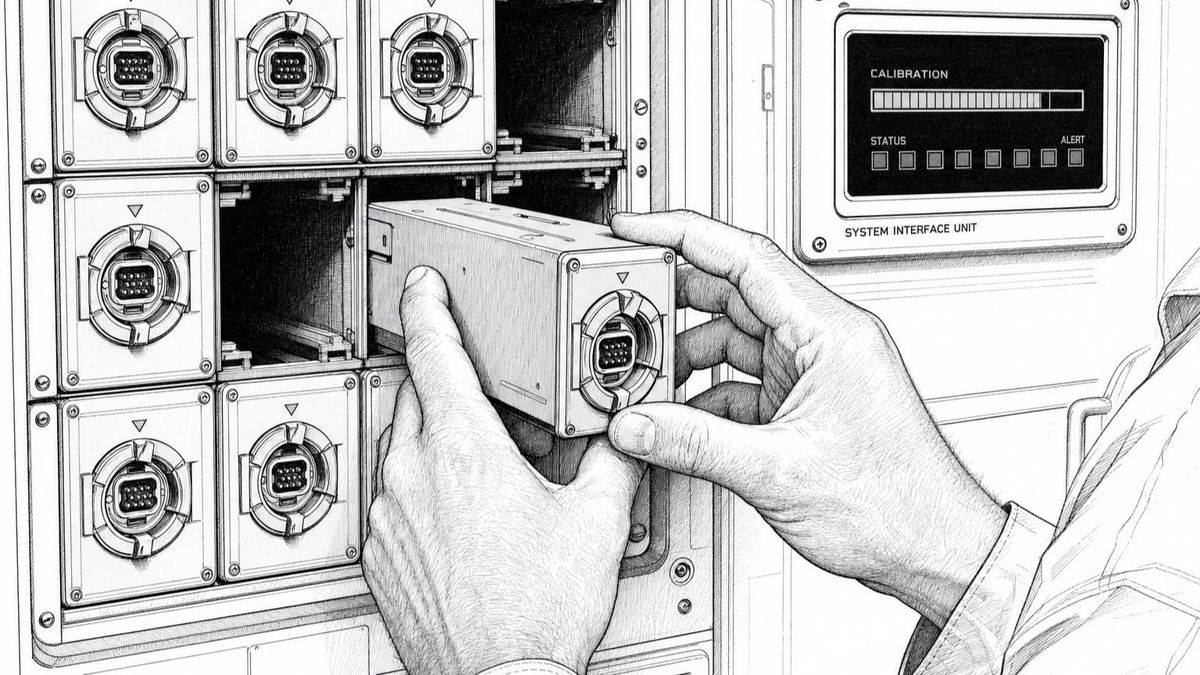
A gray box goes in a slot, and a light turns green. We didn't plan the box. We were just trying to get it there on time.
The Grey Ledger Society, with the CGCG Helix. A Milk Run and TiGGR are released under CC BY-SA 4.0. Pass the gig board.